The new AI buying committee: why security, data, and legal show up earlier
AI changes the order of enterprise evaluations. Why AEs should bring governance stakeholders into the deal early—and how to make their review productive instead of painful.
 6 min read
The first AI conversation in an enterprise deal usually starts with a business leader. They have a workflow that is slow, repetitive, expensive, or hard to scale, they have found a product that could make it better, and they want to explore it.
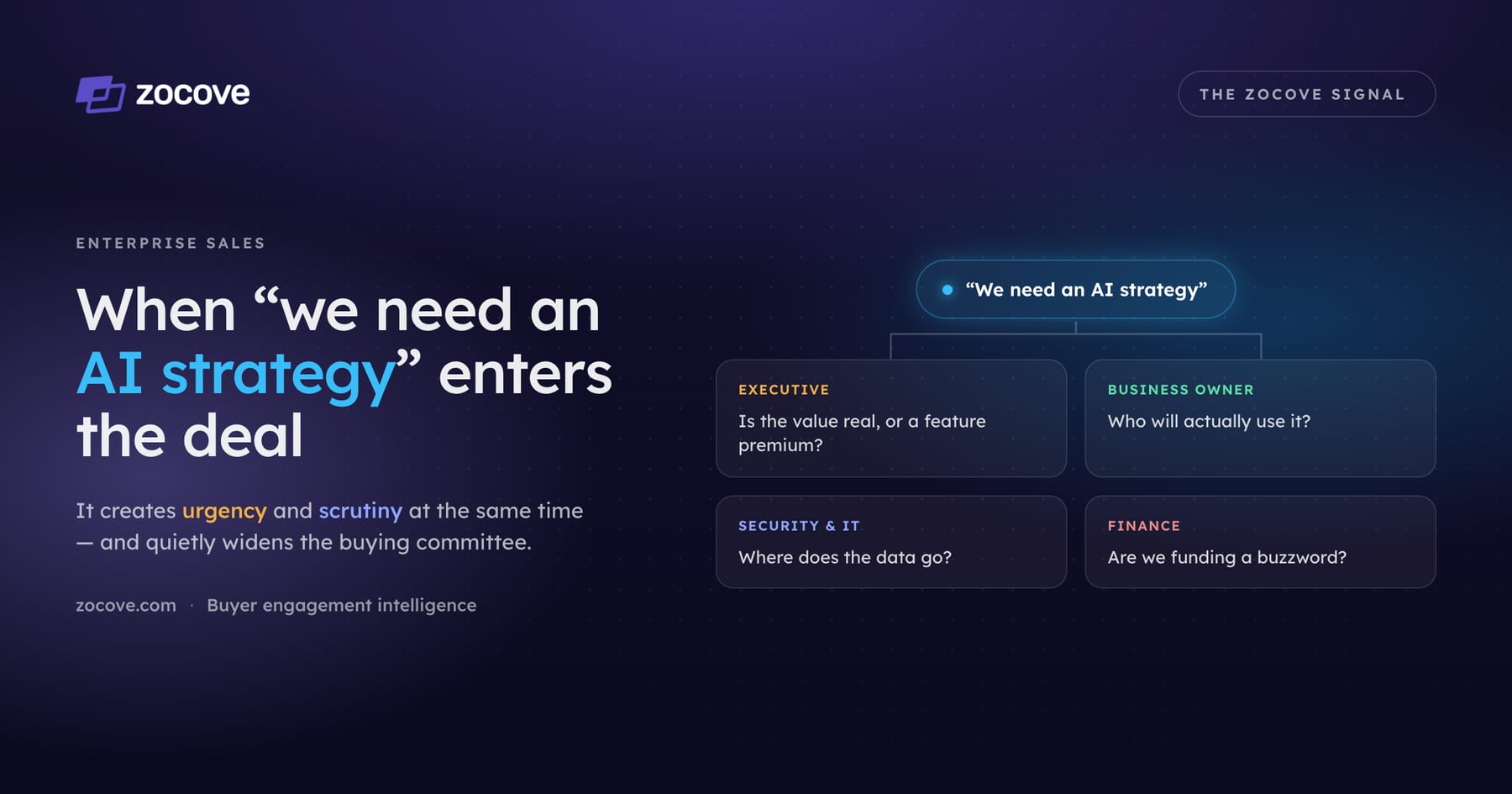
Then the deal gets real. Security wants to know what data is involved; legal wants to know what happens when the output is wrong; data asks what information gets used, retained, and connected; IT asks where the system fits; and procurement asks whether the commercial terms account for the new risk.
It is easy to read all of that as the deal getting derailed. It is not — it is the buying committee showing up.
AI changes the sequence of the deal
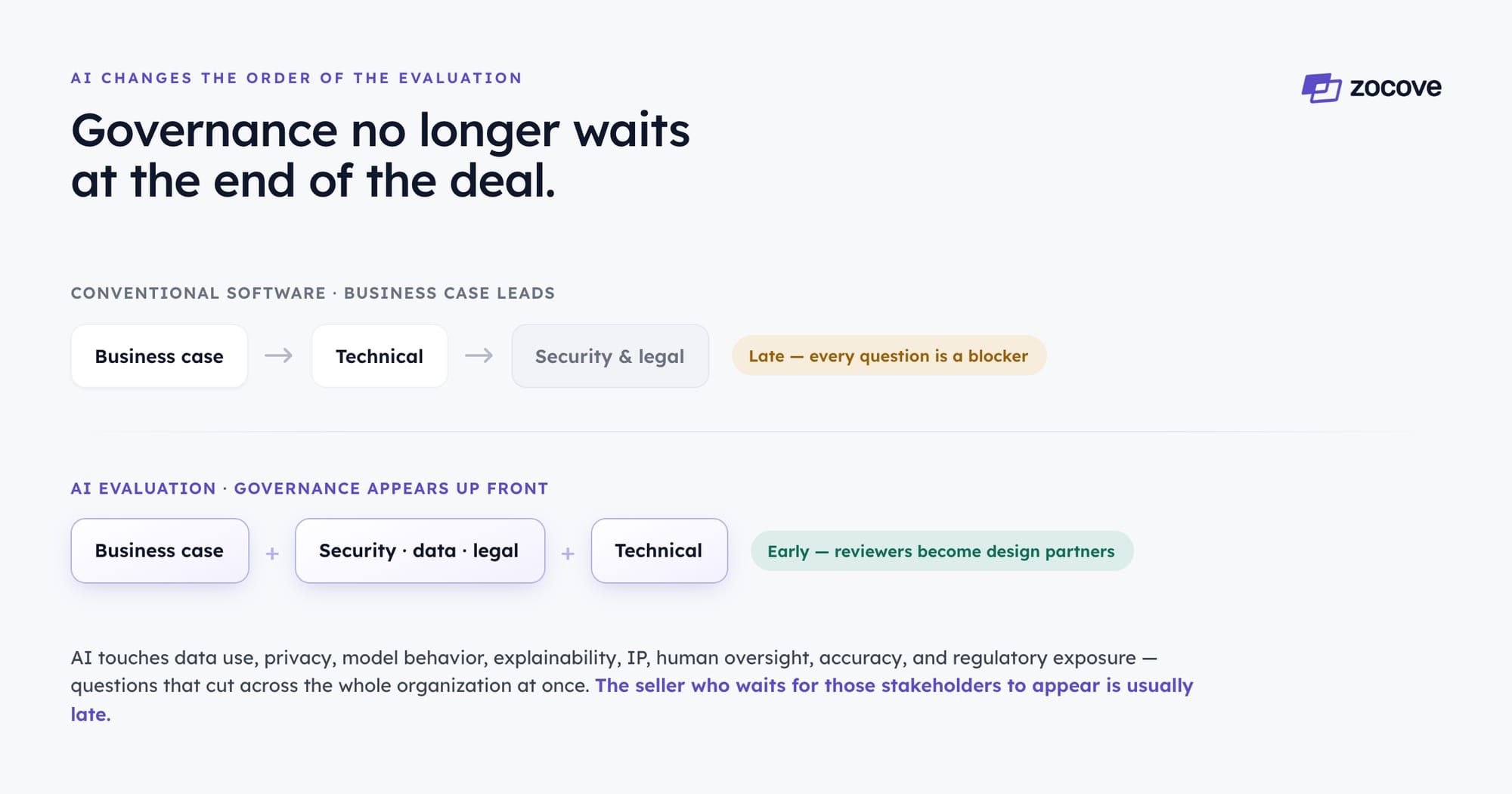
In a conventional software evaluation, the business case tends to lead, and technical, security, and legal review follow once the buyer has decided the solution is worth pursuing. With AI, those functions show up much earlier — not because AI buyers are uniquely difficult, but because AI touches questions that cut across the whole organization:
- Data use
- Privacy
- Model behavior
- Explainability
- Intellectual property
- Human oversight
- Accuracy
- Security
- Regulatory exposure
- Operational accountability
A business leader may love the outcome, but they cannot move the decision alone until the organization has answered the governance questions. The seller who waits for those stakeholders to appear is usually already late.
The wrong instinct: protect the deal from scrutiny
When a deal is moving well, it is tempting to keep the group small. The champion is engaged, the business owner is bought in, and the executive sponsor likes the story — so why introduce security or legal before you have to?
Because “before you have to” is usually the best time. Bringing the right stakeholders in early does not create risk; it reveals the risk that already exists, and it gives the team time to work through that risk without a deadline hanging over every question.
The stakeholders are not all asking the same question
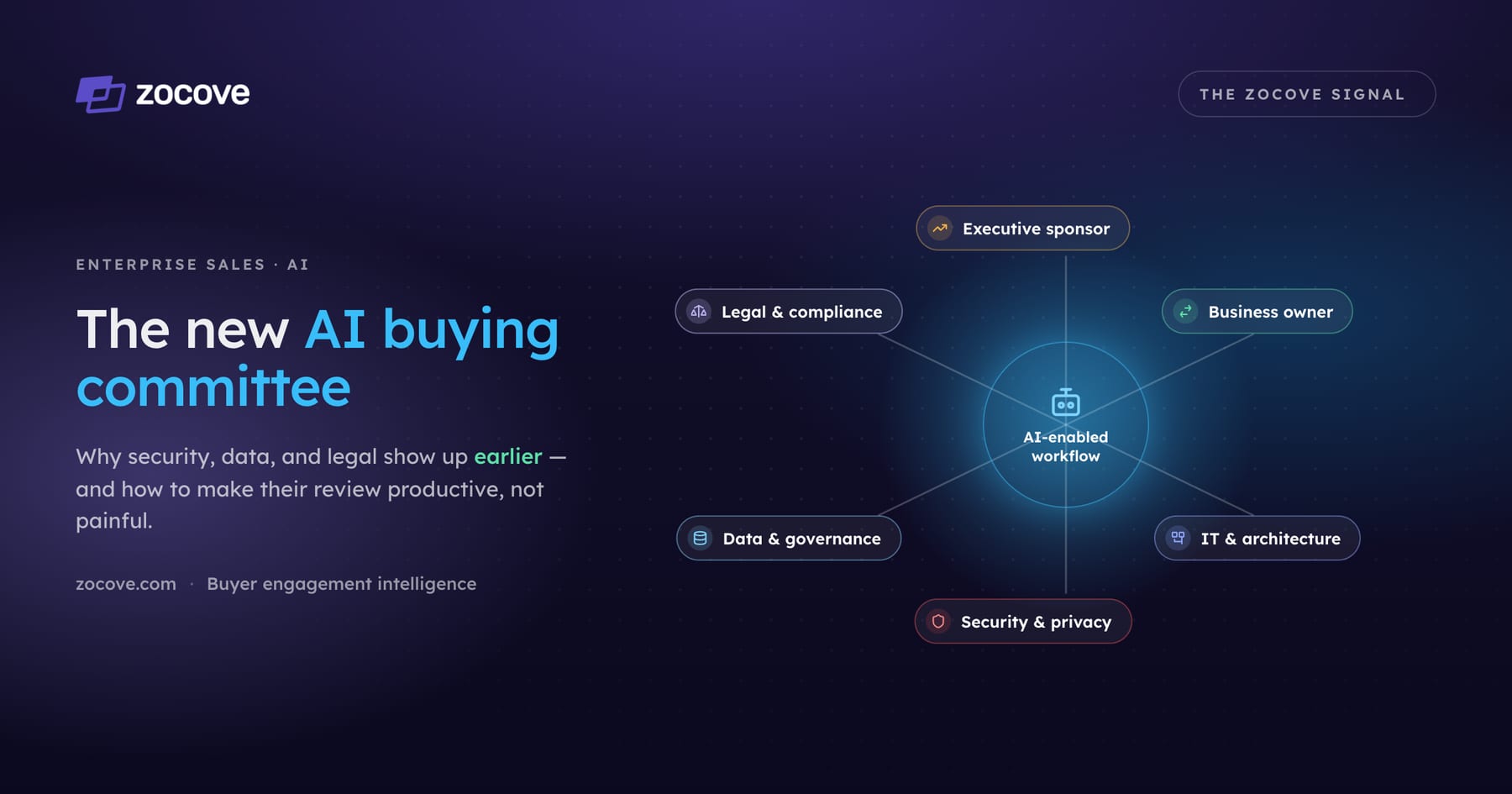
A useful way to prepare for an AI evaluation is to map each stakeholder to the decision they actually need to make.
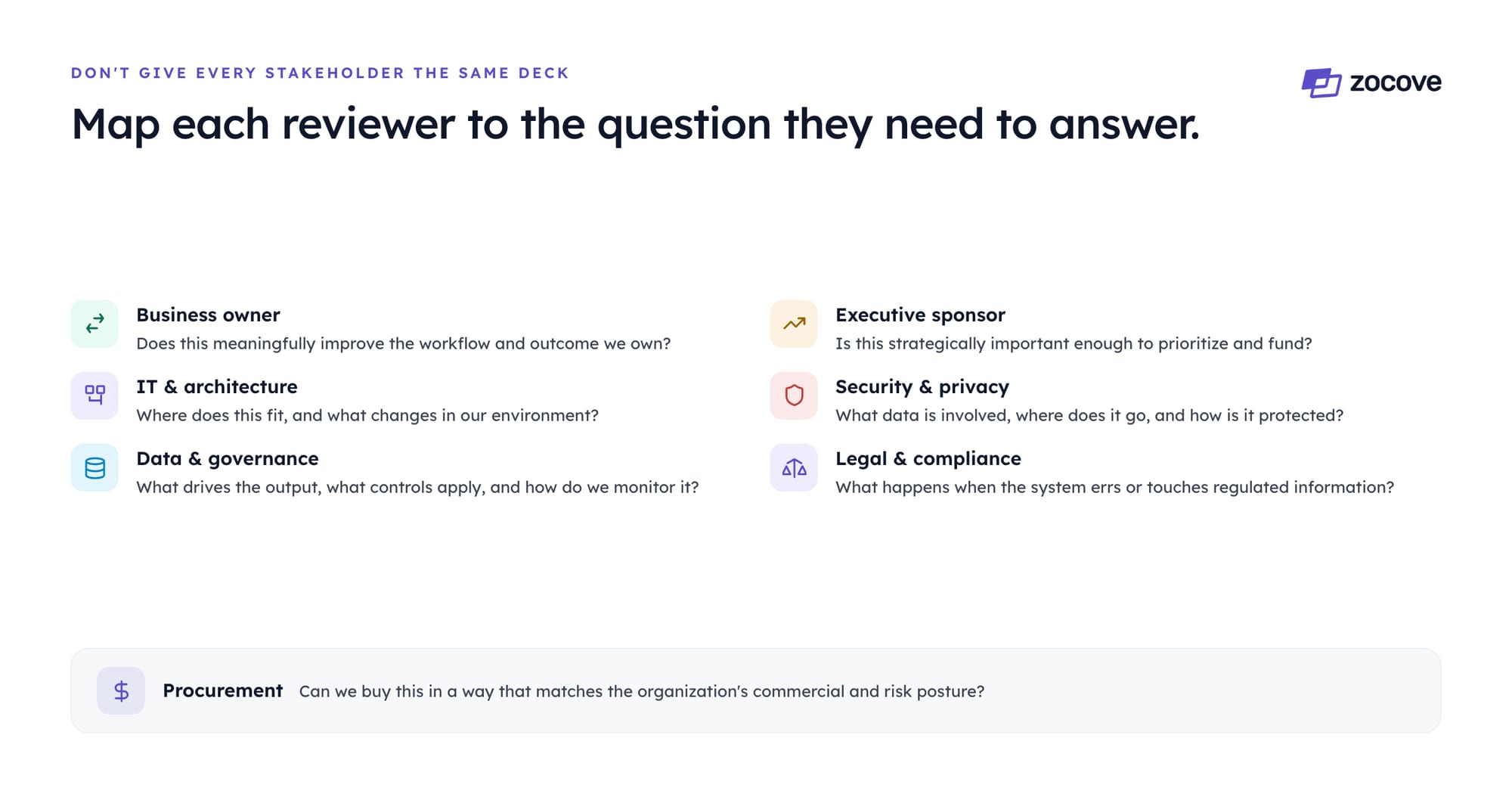
Business owner
Question: Does this meaningfully improve the workflow and outcome we own?
They need a clear before-and-after story, practical user value, and a realistic adoption path.
Executive sponsor
Question: Is this strategically important enough to prioritize and fund?
They need the why-now narrative, the business value, the risk of doing nothing, and confidence that the initiative will not turn into an AI science project.
IT and architecture
Question: Where does this fit, and what changes in our environment?
They need integration scope, system boundaries, the implementation approach, reliability expectations, and clear ownership.
Security and privacy
Question: What data is involved, where does it go, and how is it protected?
They need the security architecture, the access model, data-processing details, vendor controls, and a direct path to answers.
Data and governance
Question: What information drives the output, what controls apply, and how do we monitor it?
They need clarity on data sources, permissions, retention, quality, auditability, and how the system handles uncertainty.
Legal and compliance
Question: What happens when the system makes an error, creates risk, or touches regulated information?
They need clear terms, human-control boundaries, accountability, and an honest account of the limitations.
Procurement
Question: Can we buy this in a way that matches the organization’s commercial and risk posture?
They need a clear scope, pricing, a contracting path, and internal owner alignment.
Each of those questions is reasonable. The mistake is giving every stakeholder the same deck.
Bring a governance package, not a last-minute scramble
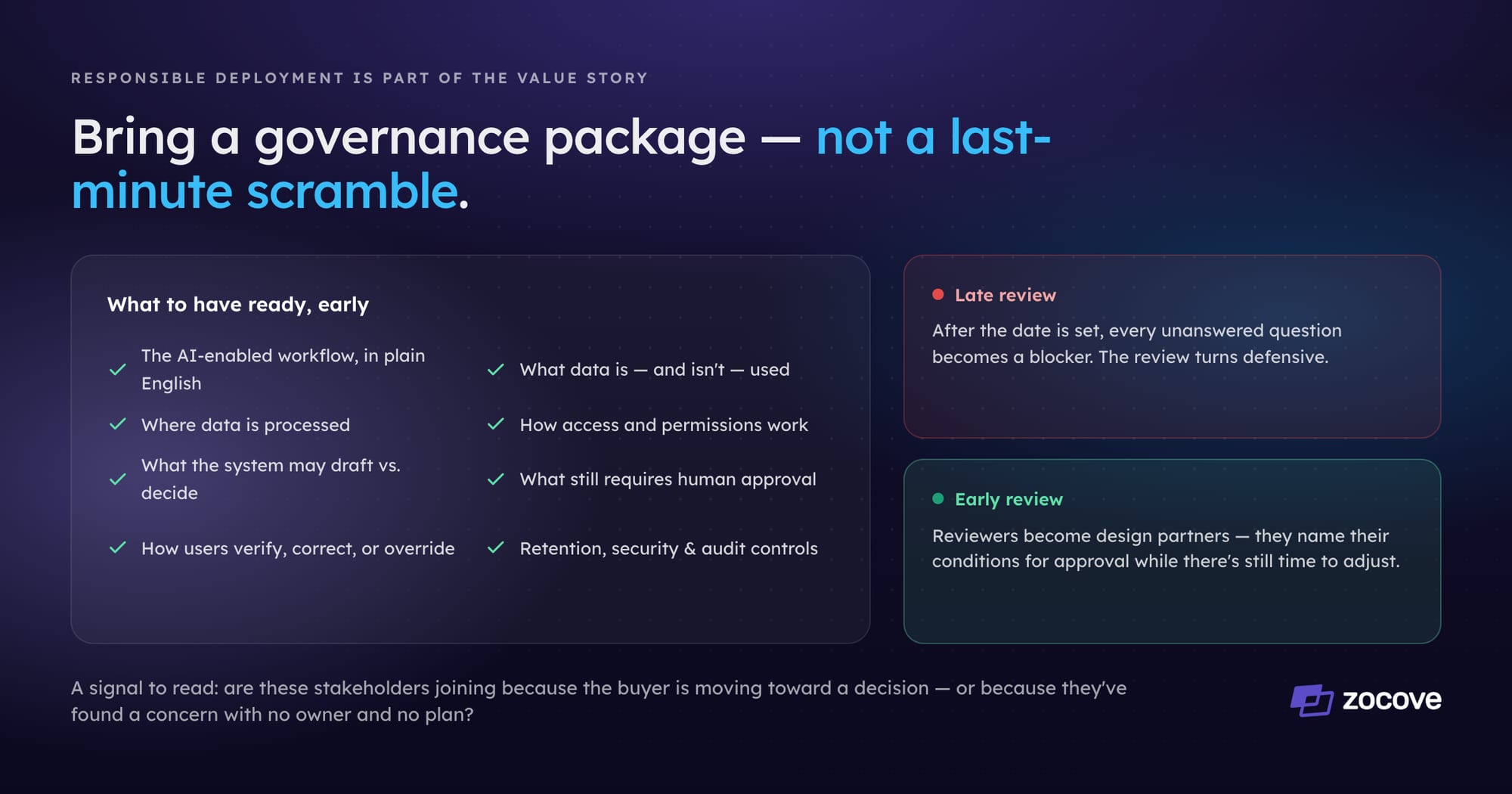
When AI is central to the product story, come to the evaluation ready with a concise governance package. It does not need to be a hundred pages; it just needs to make the first review easier. At minimum, include:
- A plain-English description of the AI-enabled workflow
- What data is used and what data is not used
- Where the data is processed
- How access and permissions work
- What the system can recommend, summarize, or draft
- What still requires human review or approval
- How users can verify, correct, or override the output
- What controls exist for retention, security, and auditability
- A clear route for deeper security and legal questions
This package does two things. First, it cuts down on unnecessary back-and-forth. Second, it tells the buyer you understand that responsible deployment is part of the value story — not an obstacle to it.
Early governance can accelerate the deal
This sounds counterintuitive, because security and legal are the functions usually blamed for slowing deals down. But late review is what actually creates the delay. When those teams are brought in only after the executive sponsor has set an aggressive target date, every unanswered question becomes a blocker, people feel pressure to approve something they did not help shape, and the review turns defensive.
Bring them in early and the conversation changes. They become design partners: they clarify what evidence they need, identify their conditions for approval, and flag issues while there is still time to adjust the plan. That makes the eventual decision far more durable.
How AEs should run the first governance conversation
Do not open the first call with a generic compliance monologue. Start with the buyer’s workflow instead:
“Before we get into controls, I want to be clear about what the system is doing in this use case, what it is not doing, and where your team stays in control.”
Then walk through it in order: the business workflow, the input data, the system behavior, the user controls, the security and governance posture, and finally the open questions that need the buyer’s guidance.
That sequence matters. It shows reviewers you are not using governance language to paper over an unclear product — you are describing a specific workflow with specific boundaries.
A practical signal for the AE
When security, data, or legal enters an AI deal, do not automatically mark the opportunity as riskier. Ask a sharper question instead:
“Are these stakeholders joining because the buyer is moving toward a decision, or because they have discovered a concern with no owner and no plan?”
The first is progress; the second needs attention. The difference comes down to whether the evaluation has clear ownership, clear questions, and a shared path to resolution.
Final thoughts
AI has expanded the enterprise buying committee. That does not make AI deals impossible — it makes them more cross-functional, and the strongest AEs design for that rather than trying to avoid it. They bring governance stakeholders in early, make the workflow concrete, explain the human controls, and give each reviewer what they need to do their job.
That is how you turn security, data, and legal from late-stage surprises into part of a credible path to yes.