The invisible buying committee
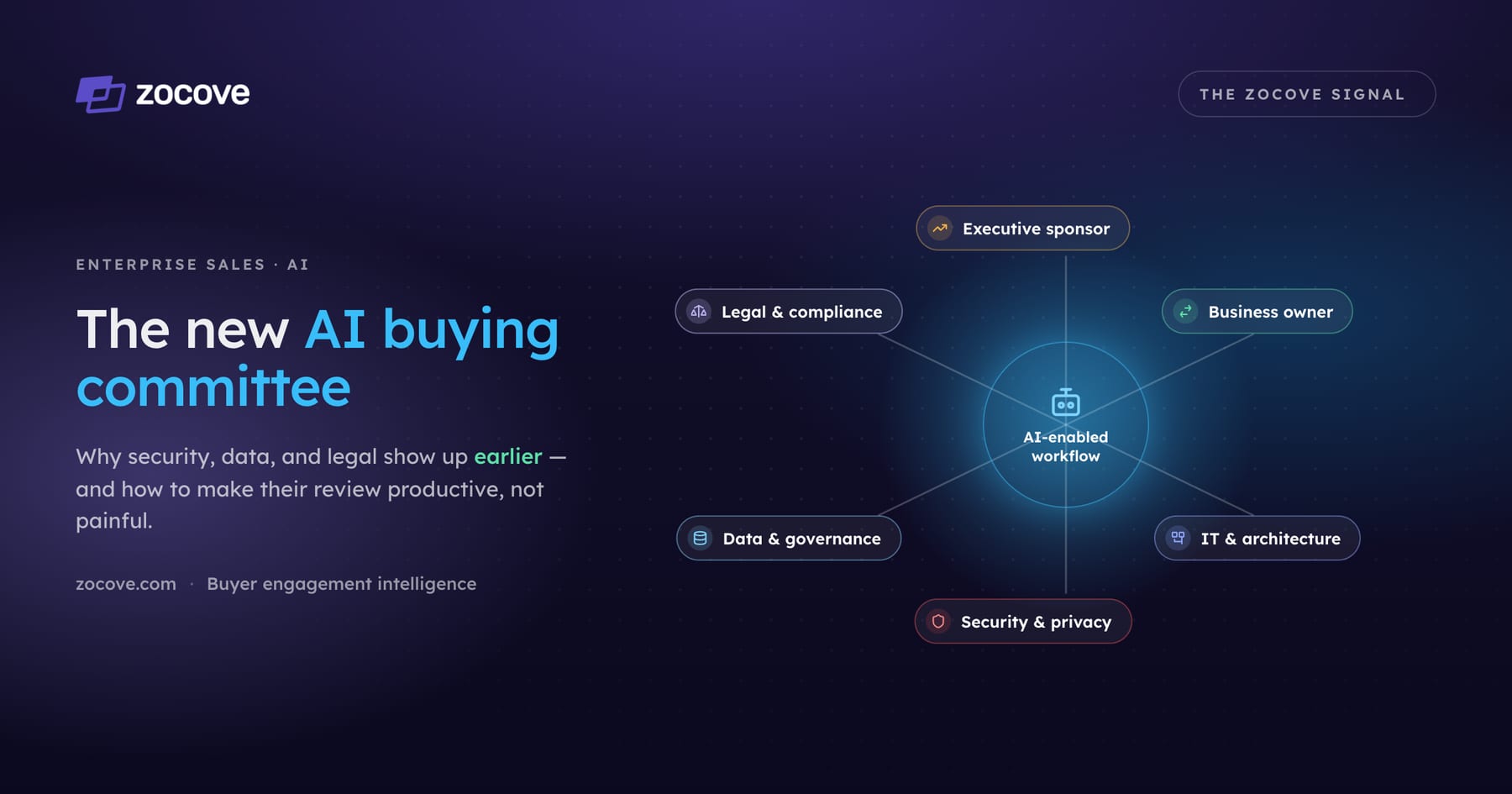
Most enterprise deals are decided by a buying committee you never meet — the hidden stakeholders who shape every deal, and the signals that reveal consensus.
 6 min read

Most enterprise deals aren't won or lost on your champion.
They're won or lost by people you never meet.
The demo went perfectly. Your champion was engaged, the questions were sharp, the business case looked strong, the emails came back fast, the mutual action plan was signed off. The forecast stayed green.
Then the deal slipped.
If you've sold enterprise software for any length of time, you know this one. A healthy-looking deal loses momentum and nothing seemed wrong. Something was. You just couldn't see it.
The myth of the champion
It's easy to lean on a single contact. Champions are visible — they show up, give feedback, answer email, push for change. They become the face of the deal.
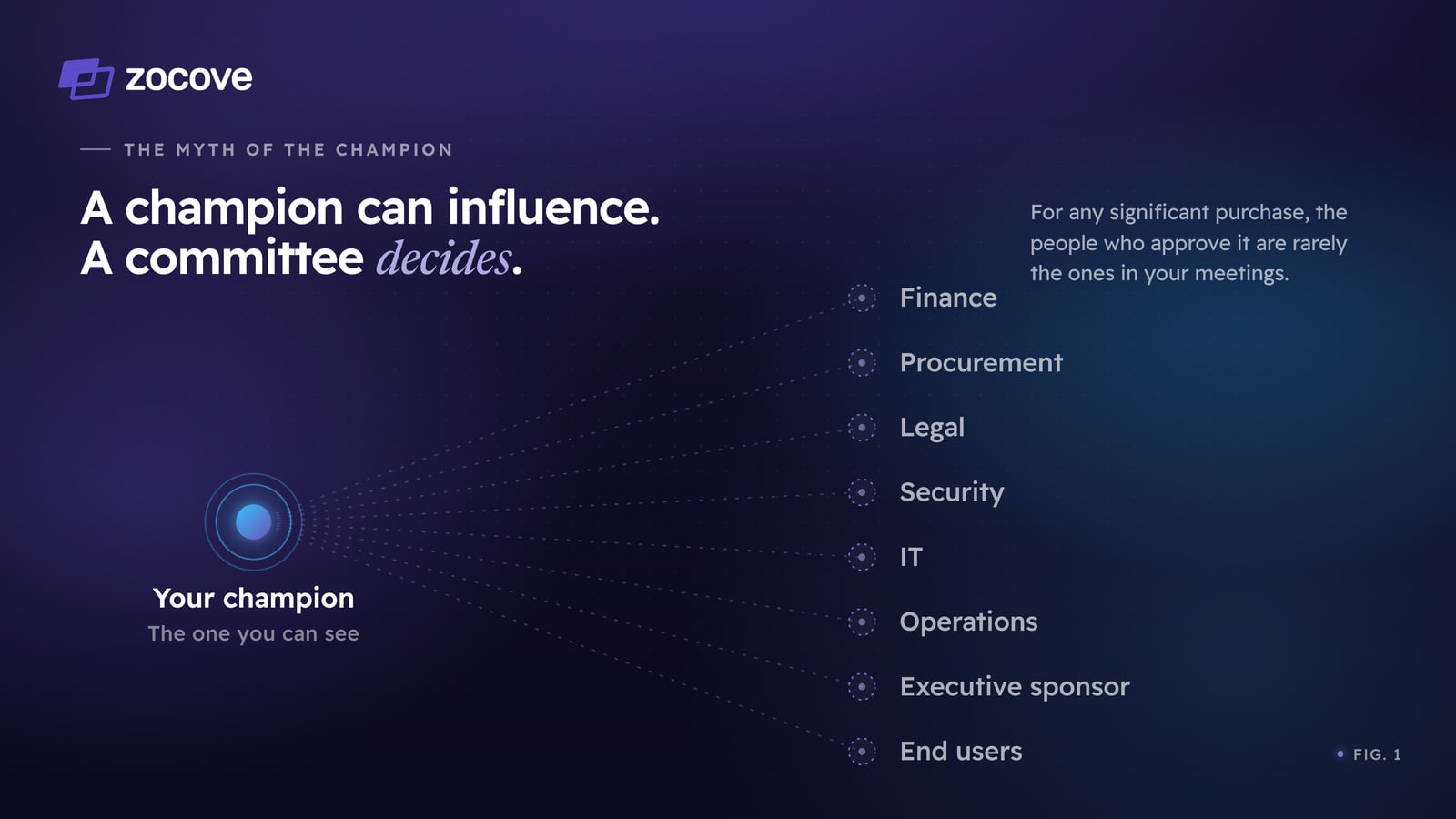
But enterprise purchases are almost never approved by one person. A champion can influence a decision. A buying committee makes it.
On a serious purchase, that committee usually includes:
- Finance
- Procurement
- Legal
- Security
- IT
- Operations
- Executive sponsors
- End users
Each one judges the deal through a different lens. Finance weighs business value. Security weighs risk. Procurement weighs process and terms. Execs weigh strategic fit. Your champion can love the product while someone you've never met stays unconvinced — and that gap is where the risk hides.
Every deal has two pipelines
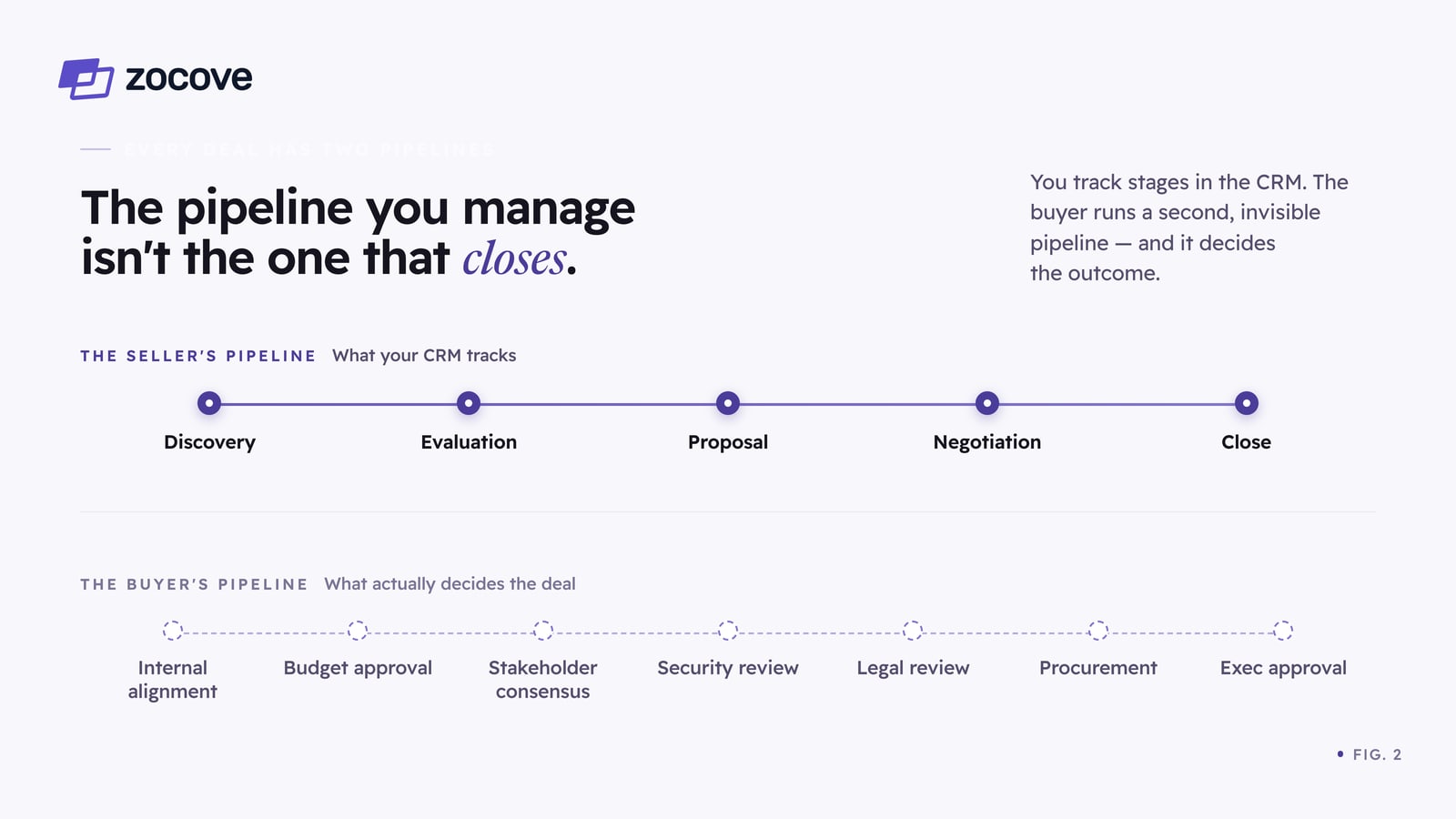
One of the most useful models in enterprise sales: every opportunity has two pipelines.
The seller's pipeline — the one you can see in the CRM:
- Discovery
- Evaluation
- Proposal
- Negotiation
- Close
The buyer's pipeline — the one you usually can't:
- Internal alignment
- Budget approval
- Stakeholder consensus
- Security review
- Legal review
- Procurement review
- Executive approval
The buyer's pipeline is the one that decides the deal. The trap is spending all your time managing the first while flying blind on the second. When a deal slips out of nowhere, it's almost always because something stalled in the buyer's pipeline long before it showed up in yours.
What you see vs. what actually exists
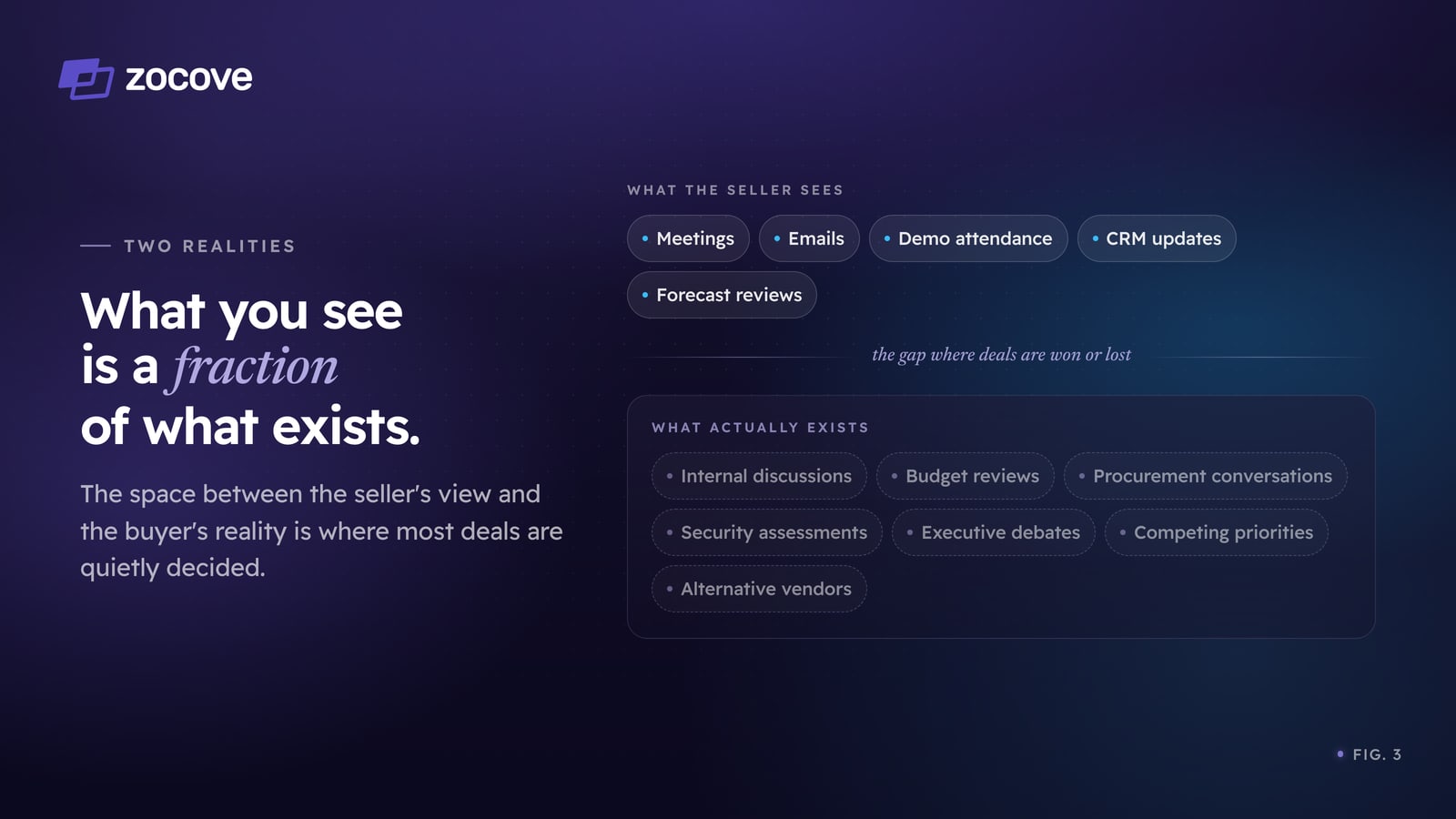
You only ever experience a sliver of the buying process.
What you see:
- Meetings
- Emails
- Demo attendance
- CRM updates
- Forecast reviews
What actually exists:
- Internal discussions
- Budget reviews
- Procurement conversations
- Security assessments
- Executive debates
- Competing priorities
- Other vendors being evaluated
The gap between those two lists is where deals are won and lost. You can feel confident because the meetings go well — while the people who actually decide the outcome don't even know the evaluation is happening.
A scenario you'll recognize
You're working a $250,000 deal. Your champion's enthusiastic, the eval team likes the product, the business case is strong. It reaches late-stage evaluation.
Then a security stakeholder joins for the first time and asks for documentation. Legal opens a review. Procurement kicks off a competitive bid. An exec asks whether doing nothing is still on the table.
In a few weeks, a deal that looked ready to close slips a full quarter. It's easy to call that a late-stage problem. It wasn't. The committee was there from day one — you just didn't find and engage it early enough.
Four signals of an invisible committee
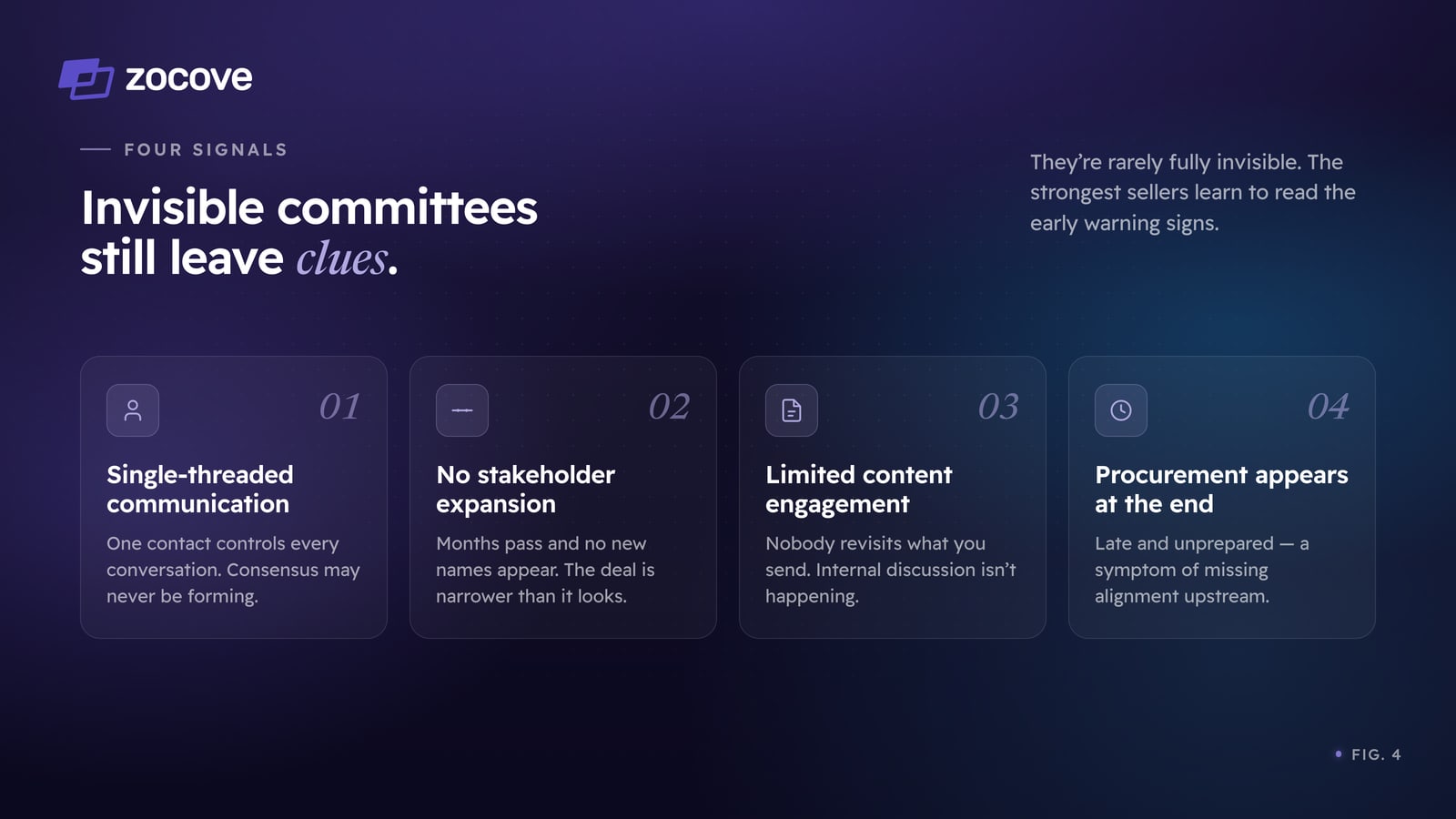
Invisible committees aren't actually invisible. They leave clues. The best sellers learn to read them.
Single-threaded communication
If one person controls every conversation, your risk is high. Healthy deals widen out over time. When only one stakeholder ever participates, consensus probably isn't forming.
No stakeholder expansion
As a deal matures, new faces should appear — each one a sign the process is moving internally. If months pass with no new stakeholders, the opportunity is narrower than it looks.
Limited content engagement
Buyers who are getting ready to decide consume information — they review materials, share them, come back to the important ones. Little engagement usually means the internal conversation isn't happening.
Procurement shows up at the end
Procurement gets blamed for delays, but it's just doing its job. The real problem is procurement arriving with no context or alignment in place — usually a symptom of a committee you never had visibility into.
Engagement is the clue
Knowing buying committees exist isn't the hard part — every experienced seller knows that. The hard part is knowing whether the committee is actually engaging.
This is where most pipelines fall short. They track your activity — emails sent, calls made, meetings held, tasks updated. Useful, but none of it tells you what the buyer is doing.
Engagement answers a different set of questions:
- Who's participating?
- Who's reviewing content?
- Which stakeholders have appeared?
- Who's gone quiet?
- Is collaboration rising or falling?
Those tend to reveal deal health earlier than any stage or forecast review. Activity measures your effort. Engagement measures your buyer's — and that's the distinction that matters.
The best sellers think like consensus builders
Average sellers focus on the champion. Great ones focus on consensus. They know enterprise deals don't close because one person says yes — they close when enough stakeholders line up behind the same outcome.
So they map stakeholders, find the decision-makers, learn the influence patterns, watch engagement, and build consensus on purpose. They don't wait for hidden stakeholders to surface — they go looking. They don't assume alignment — they verify it. And they don't read deal health off activity alone — they look for evidence the buying process is genuinely moving.
Why this matters more than ever
Enterprise buying keeps getting more complex — more stakeholders, more reviews, more scrutiny on every investment. The more complex it gets, the more visibility into the committee is worth.
The sellers who consistently outperform aren't running more demos or sending more follow-ups. They're better at understanding how the decision actually gets made inside the customer. They know deals succeed when consensus forms — and that consensus leaves a trail.
Final thoughts
Most enterprise deals don't fail because the champion wasn't sold. They fail because the rest of the committee never was — and those stakeholders stay invisible until it's too late.
The strongest sellers don't wait for procurement, legal, security, or an exec to appear out of nowhere. They watch for evidence that consensus is forming. Because by the time a deal officially stalls, the invisible committee has been sending signals for weeks. The only question is whether anyone was watching.