Why “send me something I can share internally” is a bigger signal than it sounds
That request is not a content request. It is a request for help building consensus. What enterprise AEs should send instead of another generic deck.
 6 min read
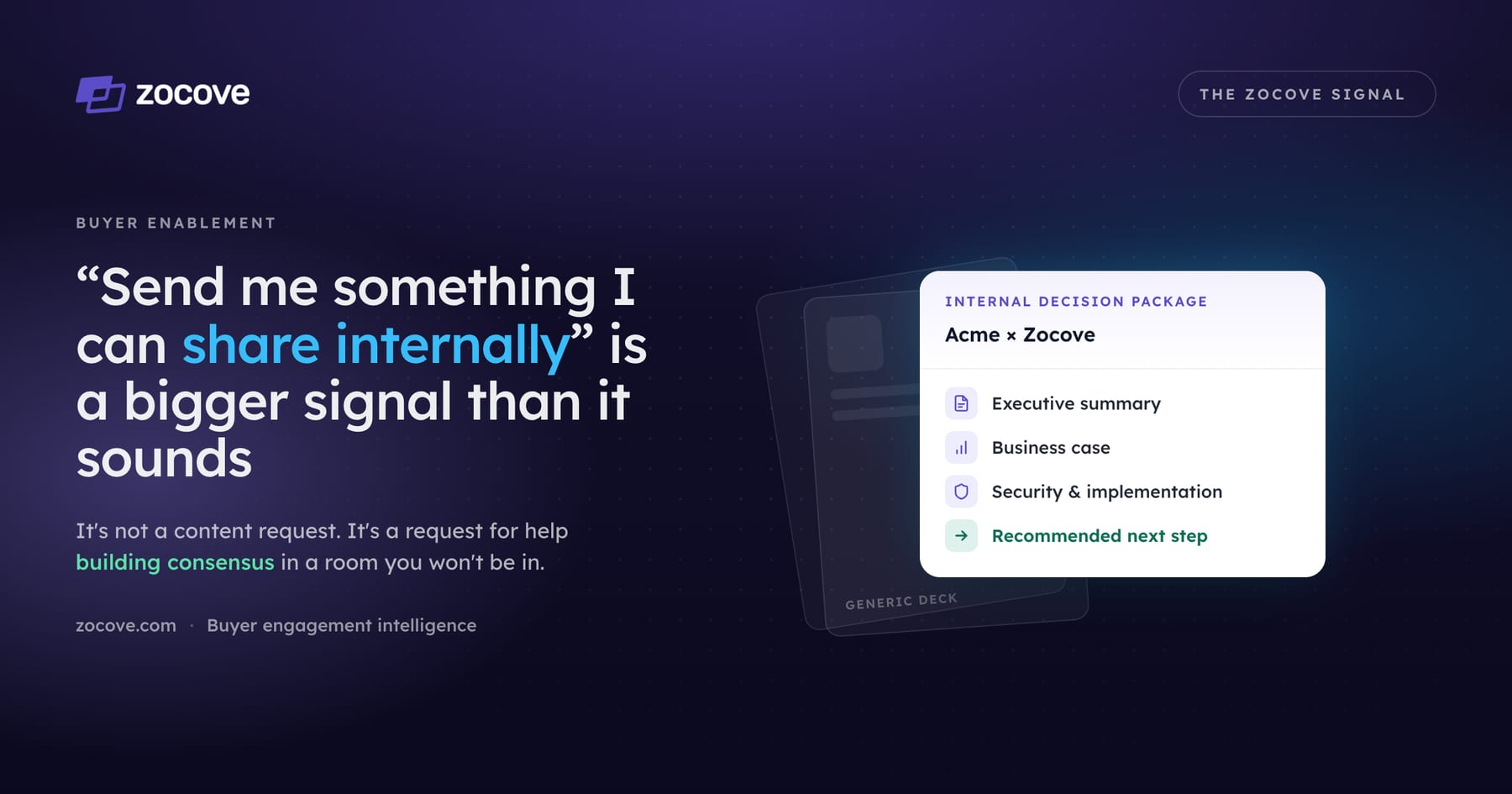
“Can you send me something I can share internally?”
Most sellers hear that and reach for the deck — maybe the latest overview, maybe the proposal, maybe the case study, maybe all three. They attach a few files, write “let me know if you have questions,” and wait.
That is understandable, but it is a missed opportunity. The buyer is not asking for content. They are asking for help carrying your case into a room you will not be in.
The request behind the request
When a champion asks for something to share internally, they are usually trying to do one of three things.
Build interest
They need a colleague, a leader, or an adjacent team to understand why this is even worth discussing.
Build confidence
They have already had the conversation, and now they need answers for the people who will challenge the decision.
Build consensus
They need to bring business, technical, financial, and operational stakeholders toward one shared view of the problem and the path forward.
A generic deck rarely does all three. It explains your product, but it does not do much to make the decision easier for everyone else in the room.
The generic-deck trap
A product deck is written for a seller-led conversation. It assumes you are there to explain the slides, answer questions, connect the features to the problem, and skip the parts that do not matter. Once the deck is forwarded internally, all of that context disappears.
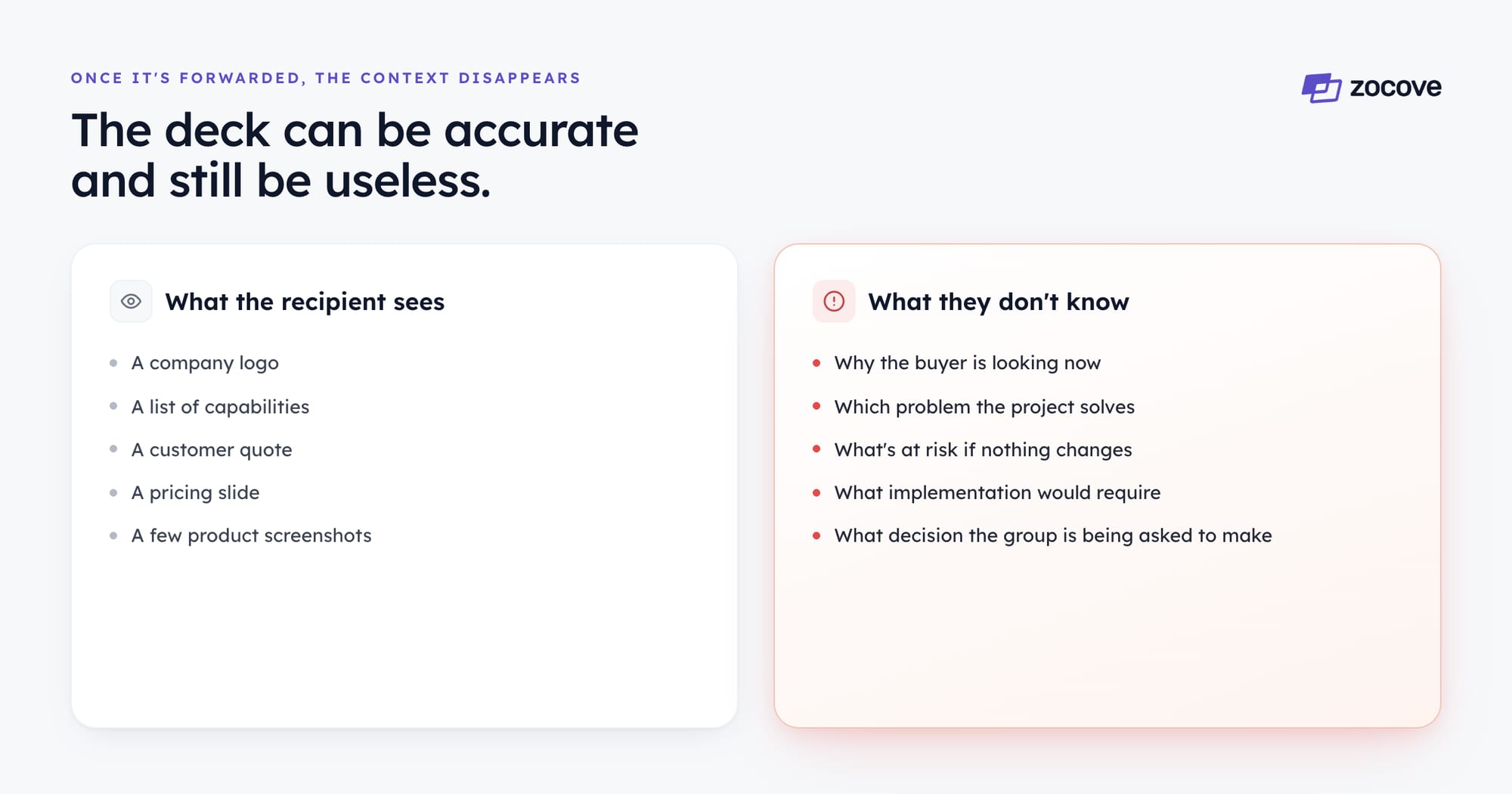
The recipient may only see a company logo, a list of capabilities, a customer quote, a pricing slide, and a few product screenshots. What they will not see is the part that actually decides things:
- why the buyer is looking now,
- which problem the project solves,
- what is at risk if nothing changes,
- why this vendor is being considered,
- what the implementation would require,
- and what decision the group is actually being asked to make.
The deck can be accurate and still be useless.
Give the champion a decision package
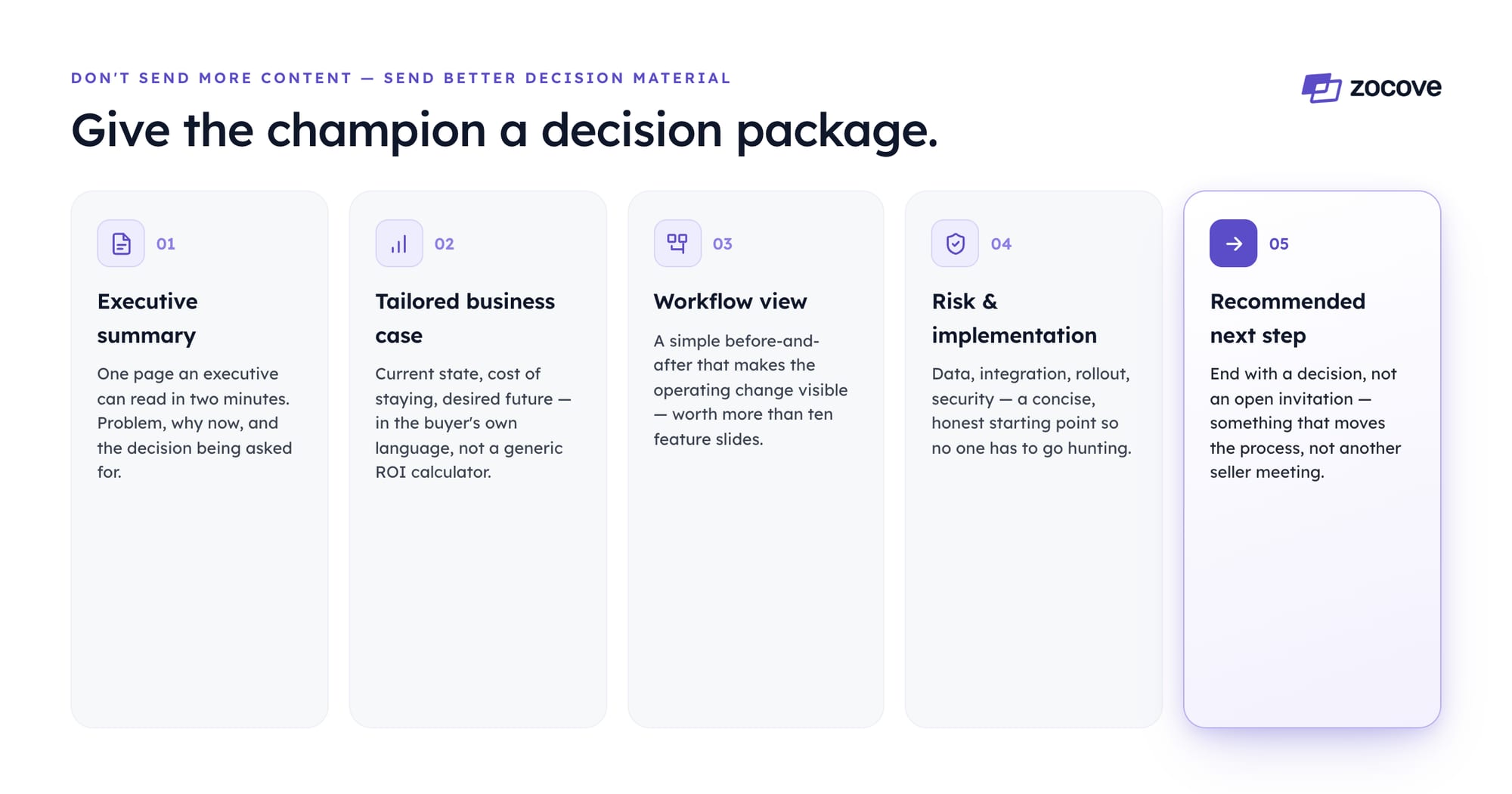
The best internal material is not one long document. It is a small package built around the decision the buyer needs to make, and it usually has five parts.
1. The executive summary
One page, and it should answer five questions: what problem are we solving, why now, what changes if we act, what is the expected value, and what decision are we asking for. This is the page an executive can read in two minutes.
2. The tailored business case
Not a generic ROI calculator, but a short, buyer-specific explanation of the current state, the cost or risk of staying there, the desired future state, the assumptions behind the value, and what success would look like. The key is to use the buyer’s language: if they call the issue “manual exception handling,” do not rewrite it as “operational inefficiency.”
3. The workflow view
Show how the work actually changes. This matters most for products that introduce AI, automation, or a new operating model, where a simple before-and-after can answer more questions than ten feature slides:
| Today | With the new approach |
|---|---|
| Team gathers information manually | Team starts with a grounded briefing |
| Questions are routed through email | Questions are organized in one place |
| Approvals happen without visibility | Owners and next steps are clear |
| Experts repeat the same analysis | Experts review, refine, and decide |
The point is not to oversimplify — it is to make the operating change visible.
4. The risk and implementation summary
This is where a lot of good deals get hard to share. Your champion may be excited, but they know someone will ask what data is involved, how it integrates, how long rollout takes, who has to be involved, what the security posture is, and what change management looks like. Give them a concise, honest starting point rather than making them hunt through a trust center, an old email, and a technical appendix.
5. The recommended next step
The package should end with a decision, not an open-ended invitation. Something like:
“Confirm the business case assumptions and identify the stakeholders required for technical validation.”
Or:
“Agree whether this is a Q3 initiative, then schedule the security and implementation review.”
The next step should help the buyer move the process, not simply book another seller meeting.
Match the material to the internal audience
One of the easiest ways to improve your deal support is to stop treating “internal” as a single audience. In practice it is several different conversations, and each one wants a different emphasis.
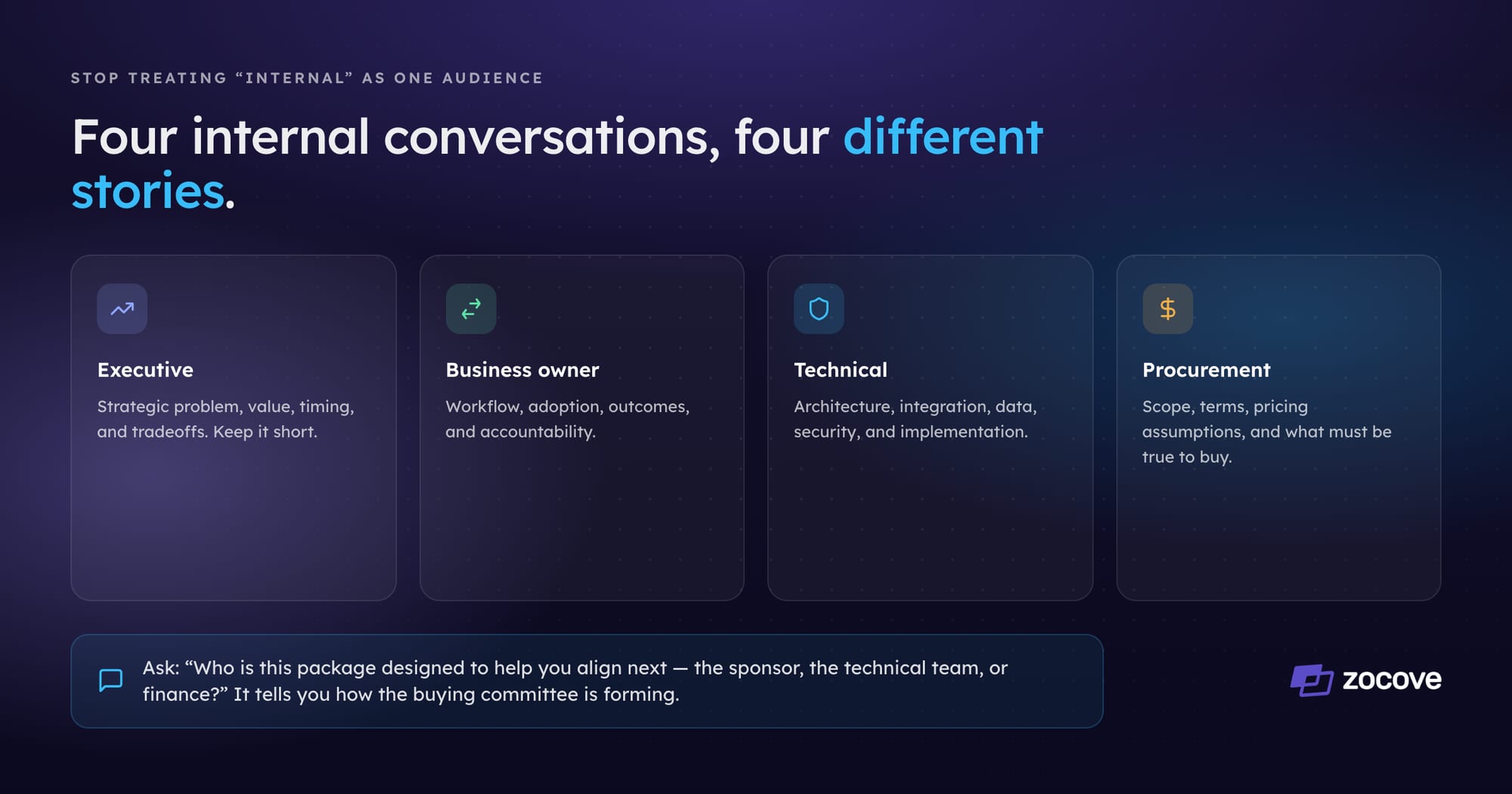
The executive conversation should stay short and focus on the strategic problem, the value, the timing, and the tradeoffs. The business-owner conversation is about workflow, adoption, outcomes, and accountability. The technical conversation is about architecture, integration, data, security, and implementation. And the procurement conversation is about scope, terms, pricing assumptions, timing, and what needs to be true to buy. Your champion may need all four, and they should not have to build them from scratch.
Make it easy to forward
The best internal material shares a few practical qualities: it is short enough to read, specific enough to matter, current enough to trust, organized enough to navigate, and clear enough that the champion can use it without you there to narrate it.
This is why a clean buyer collaboration workspace helps — not because it gives the seller more places to stash files, but because it gives the buyer one current place to find the material they need when they need it. The principle matters more than the tool, though. If the material is hard to find, hard to explain, or hard to trust, it will not build consensus.
The follow-up question that changes the conversation
After you send the material, resist the reflex to check in with “just checking if you had a chance to share this.” Try this instead:
“Who is this package designed to help you align next: the executive sponsor, the technical team, or finance?”
That question does real work. It helps the champion think about the next internal audience, and it tells you how the buying committee is forming.
Final thoughts
“Send me something I can share internally” is a good signal. It means the buyer is trying to move the conversation beyond the seller and the champion, so treat it that way: do not send more content, send better decision material.
The seller who helps a champion explain, defend, and advance the decision internally is doing more than supporting the deal. They are helping the buyer buy.