When “we need an AI strategy” enters the deal
Executive pressure to use AI can create urgency and scrutiny at the same time. How enterprise AEs can keep an AI evaluation grounded in a real workflow, a credible outcome, and a deployable plan.
 6 min read
At some point in a software evaluation, someone says it.
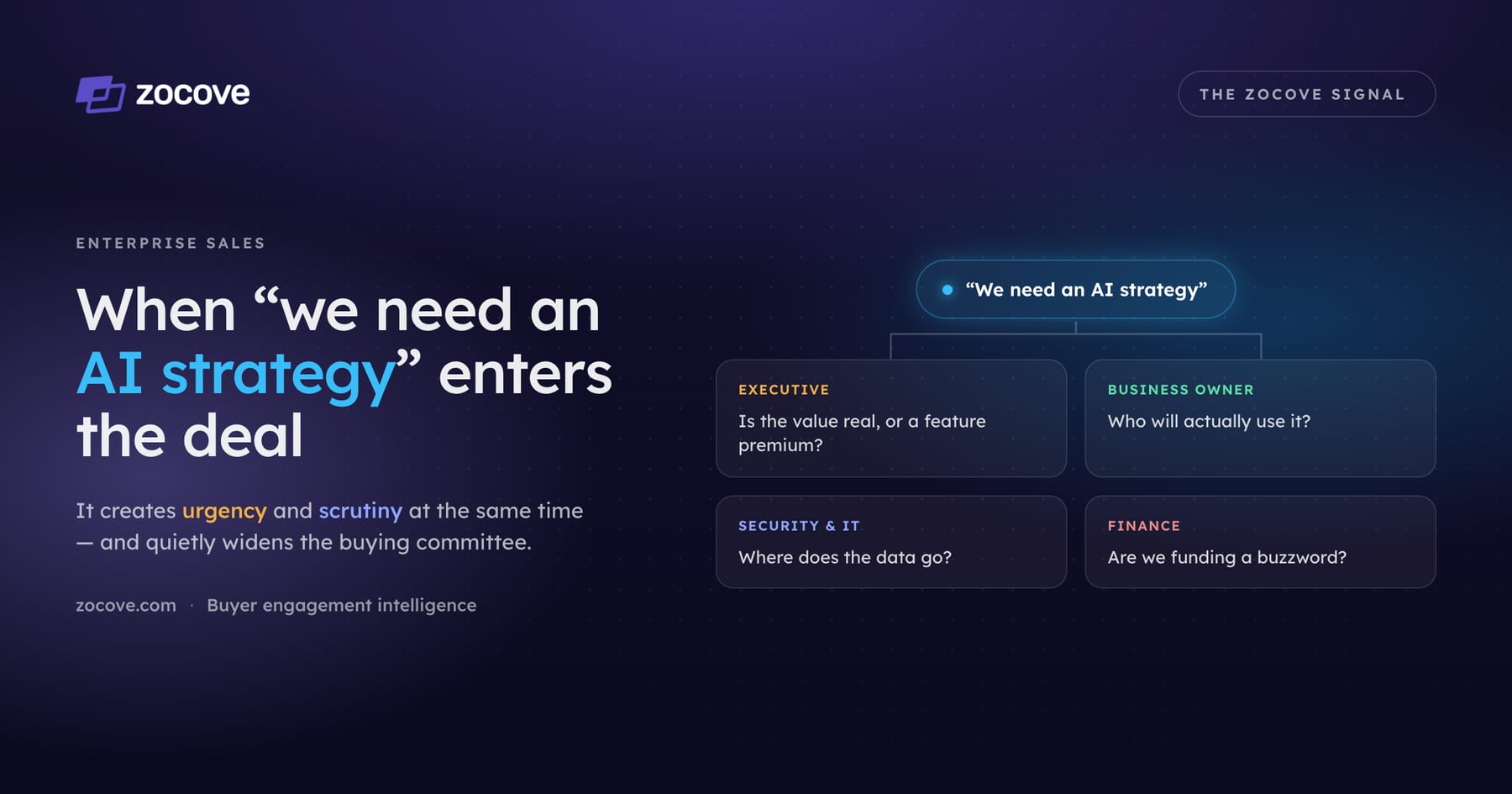
“We need an AI strategy.”
Usually it comes from an executive, but it can just as easily come from the board, a new CIO, a CEO who has just watched a competitor announce an AI initiative, or a business leader whose team keeps getting asked how they use AI and does not want to be the one without an answer.
For the seller, it can sound like good news. AI creates urgency, it gets senior attention, and it can make a slow evaluation suddenly feel strategic. It also changes the deal: the buyer is no longer only asking whether your software solves a problem, but whether it helps them answer an executive mandate without creating a new governance, adoption, or credibility problem.
AI urgency is real. So is AI scrutiny.
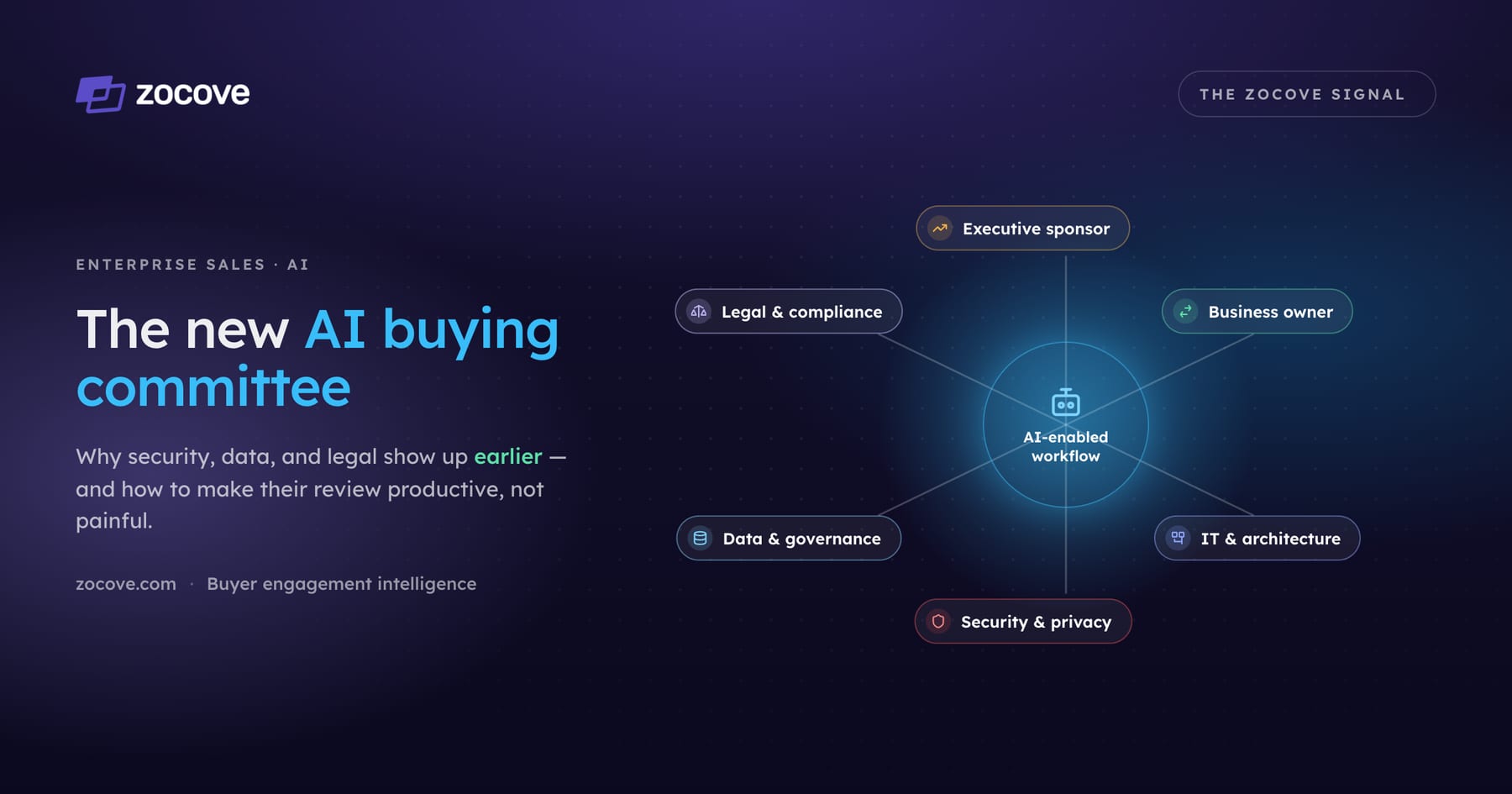
Most enterprises are using AI somewhere, but far fewer have moved from experimentation to durable, scaled value — and that gap matters in a sales cycle. The executive sponsor may want a strong AI story, the business owner a better workflow, IT a clear view of the architecture, security an answer on where the data goes, legal a read on the risk, and finance a straight answer on whether the value is real or just an expensive feature premium.
Every one of those questions is reasonable. The mistake is treating them as a sign that the deal is getting harder for no reason. They are not a distraction from the deal — they are the deal.
The wrong response: AI feature dumping
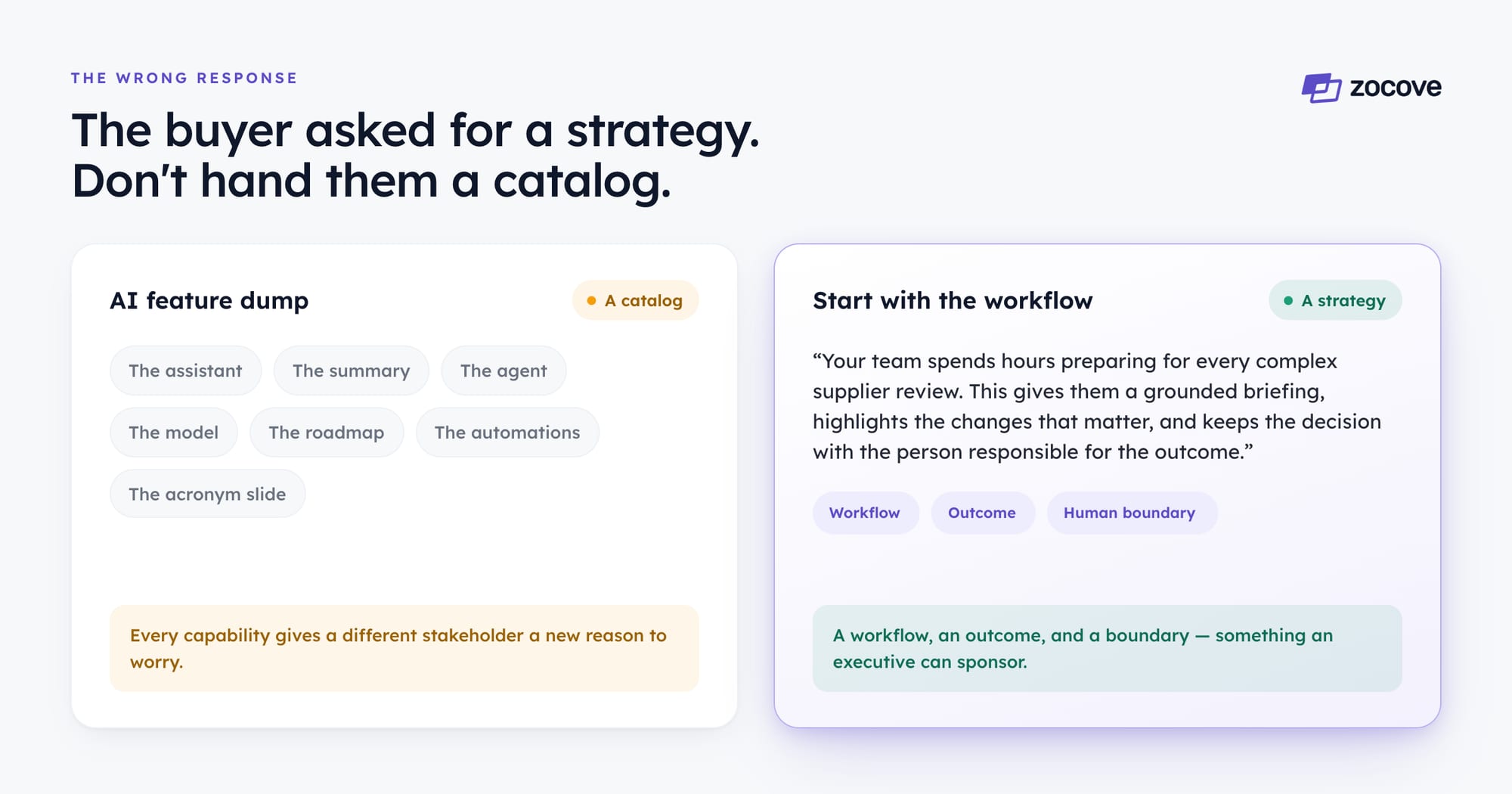
When a buyer says they need an AI strategy, many sellers respond by showing every AI capability they have — the assistant, the summary feature, the agent, the model, the roadmap, the automations, the acronym slide. It rarely helps.
A long feature tour just gives each stakeholder a different reason to worry:
- The executive wonders whether the value is concrete
- The business owner wonders who will actually use it
- IT wonders how much integration work is hidden
- Security wonders what data is exposed
- Legal wonders what happens when it is wrong
- Procurement wonders whether they are paying for a buzzword
The buyer asked for a strategy, and you handed them a catalog.
Start with the workflow that changes
The strongest AI business cases are not built around model capability; they are built around a specific workflow that becomes meaningfully better. So before you talk about the model, ask where the work is:
- What work takes too long today?
- Where do experts spend time looking for, summarizing, comparing, or routing information?
- Where does the current process create delay, inconsistency, or risk?
- What judgment should remain human?
- What would improve if the team could act with more context?
Then explain the AI in that context. Instead of “our product uses AI to generate insights,” you get something a stakeholder can actually picture:
“Your team spends hours preparing for every complex supplier review. This gives them a grounded briefing, highlights the changes that matter, and keeps the decision with the person responsible for the outcome.”
The second version has a workflow, an outcome, and a boundary — and that is what an executive can sponsor.
Every AI evaluation has four questions
When AI enters the deal, assume the buyer is trying to answer four questions at once.
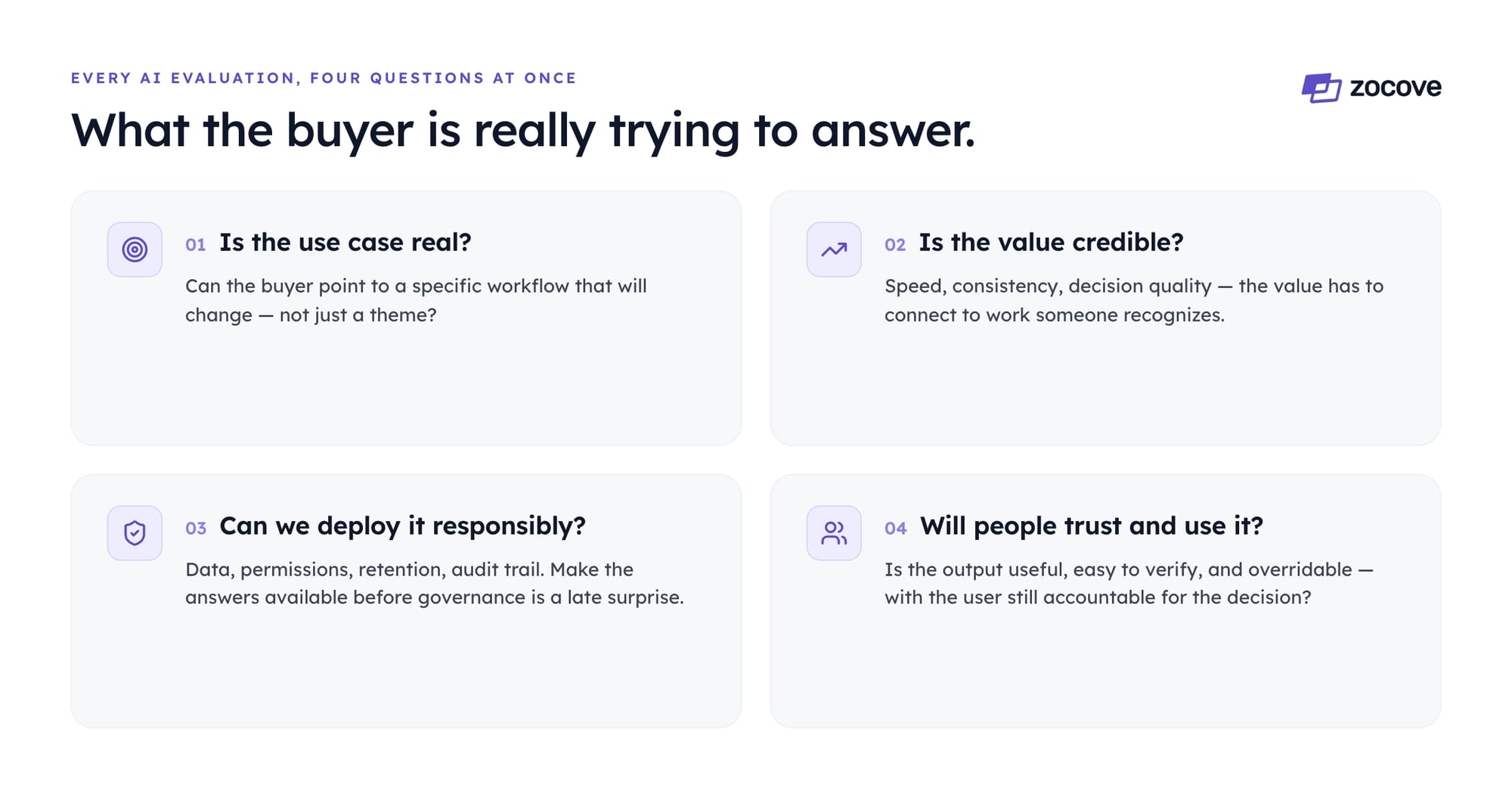
1. Is the use case real?
Can the buyer point to a specific workflow that will change? If the answer is vague, the initiative may win executive attention but never become an operational priority.
2. Is the value credible?
What actually improves? Speed is one answer and better consistency another; stronger decision quality, less risk, a better customer experience, and more capacity can all count too. Whatever it is, the value has to connect to work someone in the room recognizes.
3. Can we deploy it responsibly?
This is where security, legal, data, and governance come in. A mature buyer is not trying to kill the project — they are trying to understand how it fits, which means questions like:
- What data is used?
- Where is it processed?
- What are the permissions?
- What is retained?
- What does the system do when it is uncertain?
- Who reviews the output?
- What is the audit trail?
The faster you make those answers available, the less likely governance is to become a late-stage surprise.
4. Will people trust and use it?
AI that looks impressive in a demo can still fail in a real workflow, so the buyer needs to know:
- Is the output useful?
- Is it easy to verify?
- Can people override it?
- Does it fit the way the team already works?
- Is the user still accountable for the decision?
The strongest implementations usually preserve human judgment where judgment actually matters.
The executive sponsor and the operating buyer need different stories
This is where a lot of AI deals lose momentum. The executive sponsor wants a strategic story:
- Competitive advantage
- Innovation
- Productivity
- Better customer experience
- A credible AI posture
The operating buyer needs a practical one:
- What changes on Monday morning
- What data is required
- What they need to review
- What gets easier
- What does not change
- What happens when the AI is wrong
You need both, because they do different jobs. A slide about market leadership may win over the executive, but it will not get security through a review; a detailed architecture diagram may satisfy IT, but it will not help a CFO decide whether the initiative deserves funding. The seller’s job is to build the bridge between the two.
How to keep the deal grounded
When an AI mandate enters an evaluation, five things keep it grounded.
Name the business decision
Get specific about what the buyer actually needs to approve. “AI transformation” is not a decision anyone can sign off on.
Map the changed workflow
Show the before and after, including the person who does the work, the information they need, the decision they own, and the exact point where AI helps.
Make governance visible early
Bring the security, legal, privacy, and data questions forward yourself. A late governance surprise is not really a security problem — it is a deal-design problem.
Be clear about human control
Spell out what the AI recommends, summarizes, drafts, or flags, and what the user still approves, sends, decides, or owns.
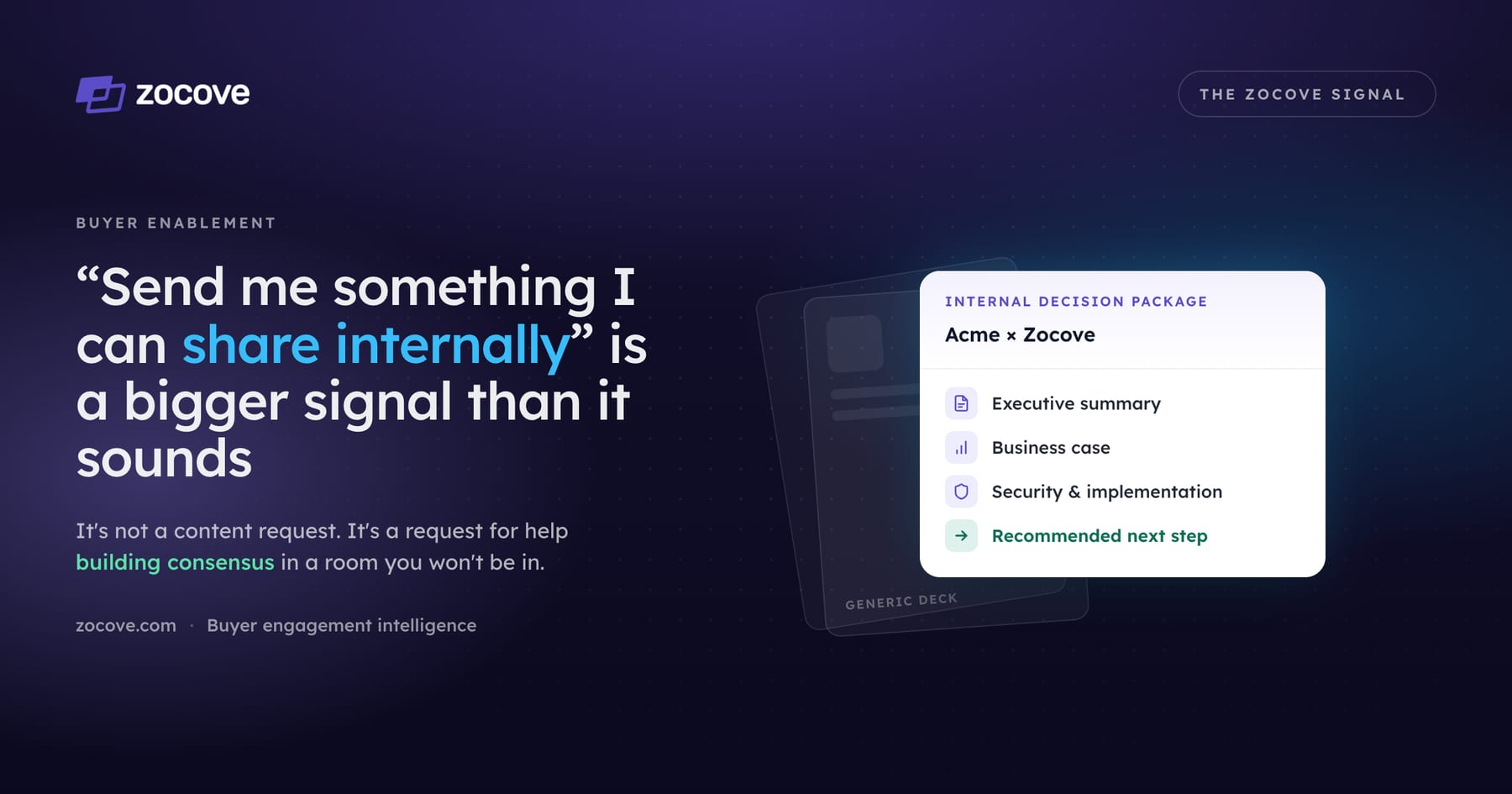
Give the champion a credible internal package
Your champion will have to explain the AI story to people with very different concerns, so give them the raw material:
- an executive narrative,
- a workflow view,
- a security and data summary,
- an implementation approach,
- and a clear explanation of the human controls.
Final thoughts
AI can create real urgency in a software evaluation, but it also creates a broader buying committee, more scrutiny, and a higher bar for proof. That is not a reason to avoid the conversation; it is a reason to make it more concrete.
The sellers who win AI evaluations are not the ones who say “AI” most often. They are the ones who can show what changes, why it matters, how it is governed, and where people stay in control. That is an AI strategy a buyer can actually buy.