The difference between a busy deal and a buying deal
A full calendar can create false confidence. How enterprise AEs can distinguish activity from the evidence that an organization is actually moving toward a decision.
 6 min read
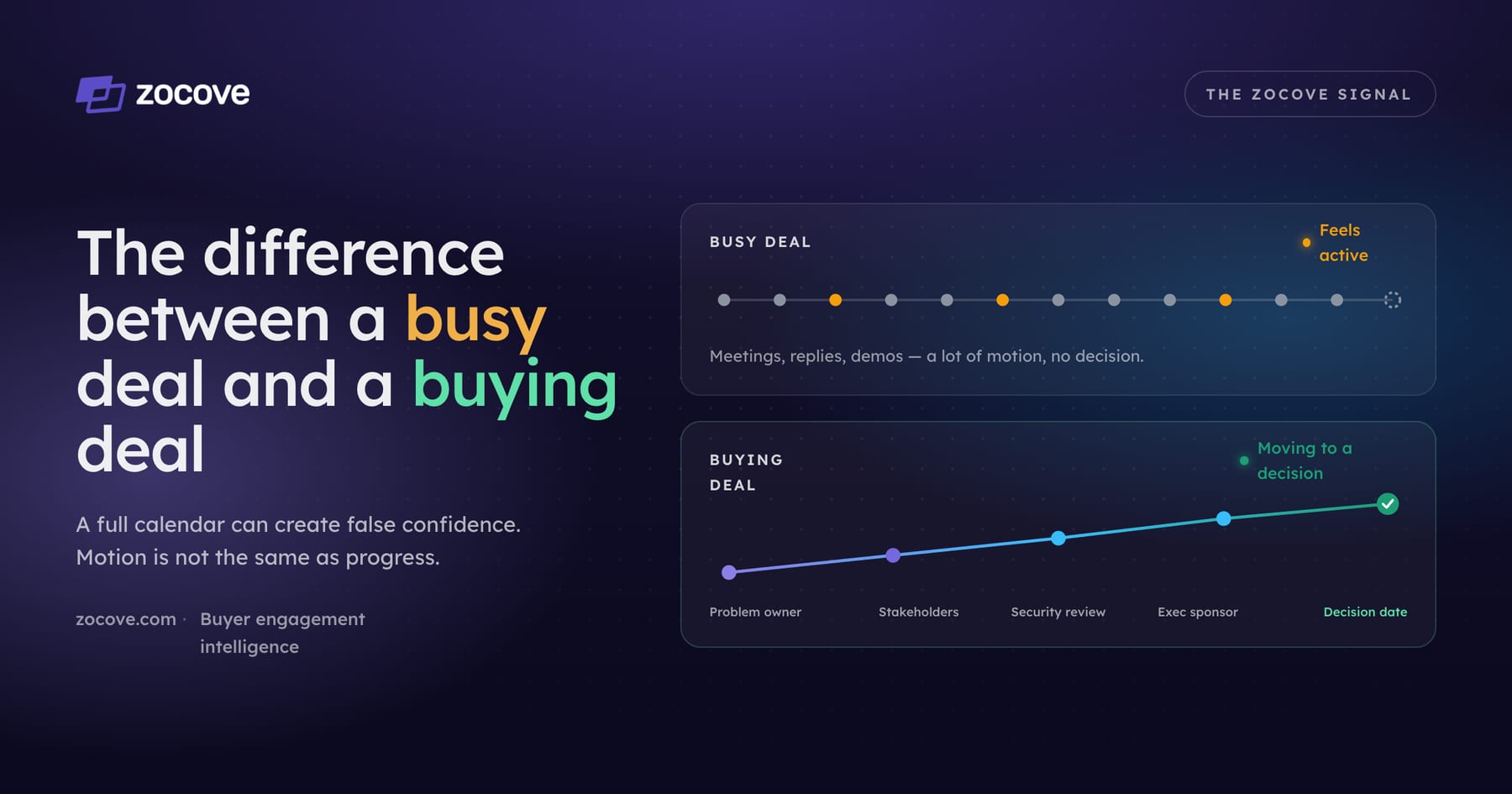
Some deals are busy. There are meetings every week, the champion replies quickly, the demo went well, the team asks smart questions, and a new request lands in your inbox every few days. The calendar is full — but a full calendar does not mean the deal is buying.
That gap is one of the most expensive mistakes in enterprise sales: confusing motion with progress. A busy deal can keep an AE occupied for months; a buying deal creates evidence that the customer is moving toward a decision. Those are not the same thing.
What a busy deal looks like
Busy deals feel great, because they produce all the signals sellers are trained to value:
- A lot of meetings
- Fast email replies
- Product questions
- Requests for more information
- A responsive champion
- A next step on the calendar
- A CRM record that looks active
None of those are bad. They are just incomplete. A busy deal can still be stuck in an endless loop of discovery, comparison, or internal uncertainty — the buyer may be learning, keeping their options open, or collecting information for some future initiative. They may even like you. But liking the conversation is not the same as choosing to change.
What a buying deal looks like
A buying deal produces a different kind of evidence: the organization starts doing work that only makes sense if it is trying to reach a decision. You see things like:
- A clear problem owner emerging
- New stakeholders joining for a reason
- Evaluation criteria becoming specific
- The buyer asking how implementation would work
- Finance pressure-testing the business case
- Security or legal beginning a real review
- Procurement asking about commercial mechanics
- The champion asking for material to use internally
- A buyer-owned next step with a date
- A decision process that becomes more concrete over time
The difference is simple:
A busy deal creates activity. A buying deal creates commitment.
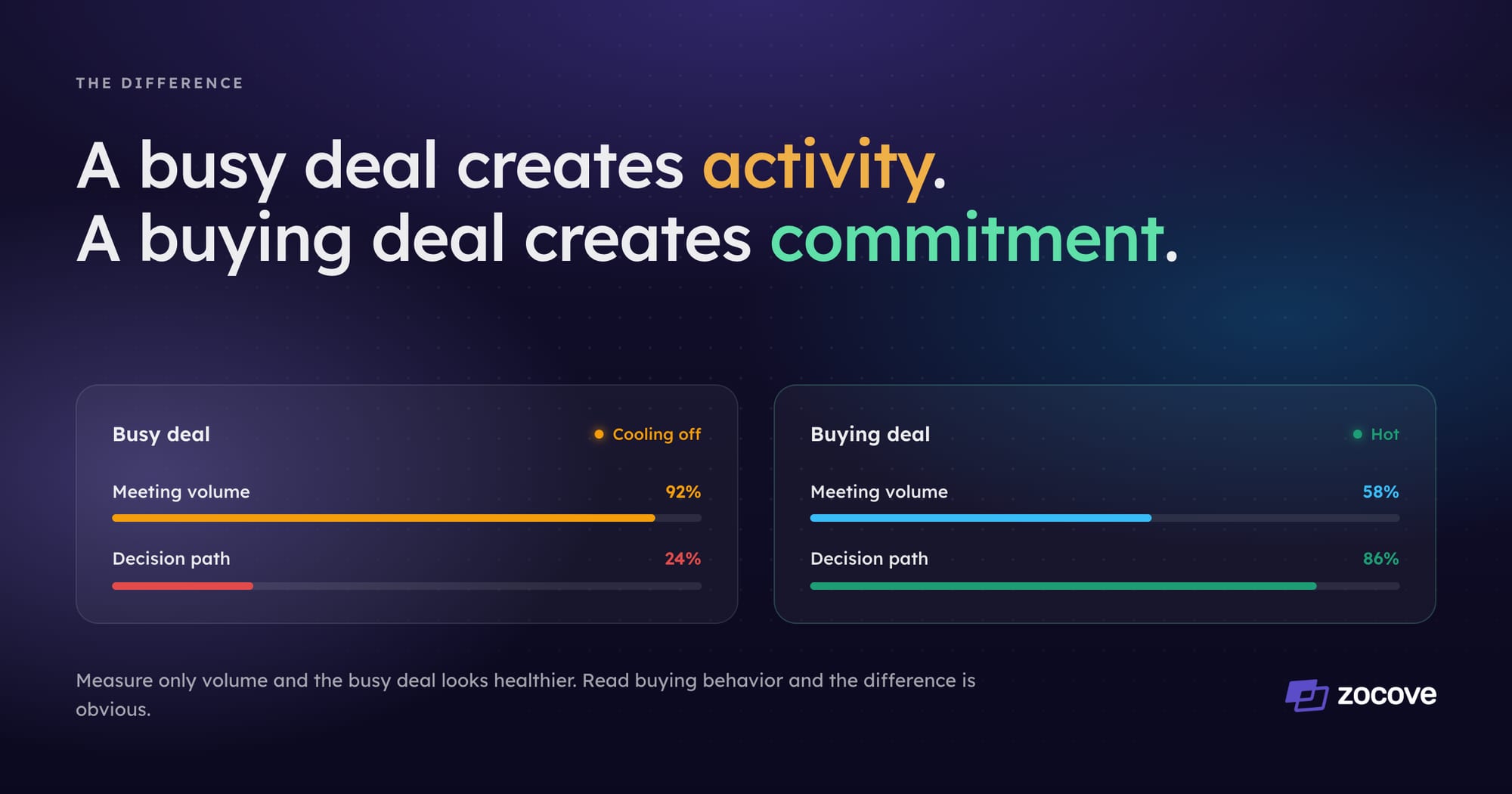
And commitment rarely looks dramatic. More often, it just looks like the buyer taking on work.
The two-deal test
Take two opportunities.
Deal A
- Weekly meetings
- Product questions after every call
- A champion who responds within hours
- A technical team that wants another demo
- No executive sponsor
- No agreed decision process
- No clear owner for the business case
- No sign that budget or procurement has started
Deal B
- Fewer meetings
- Longer gaps between calls
- A champion who asks for a one-page executive summary
- Finance joins to review assumptions
- Security asks for architecture documentation
- Procurement asks about terms and timing
- A named executive sponsor wants a short business case
- The buyer proposes the next internal milestone
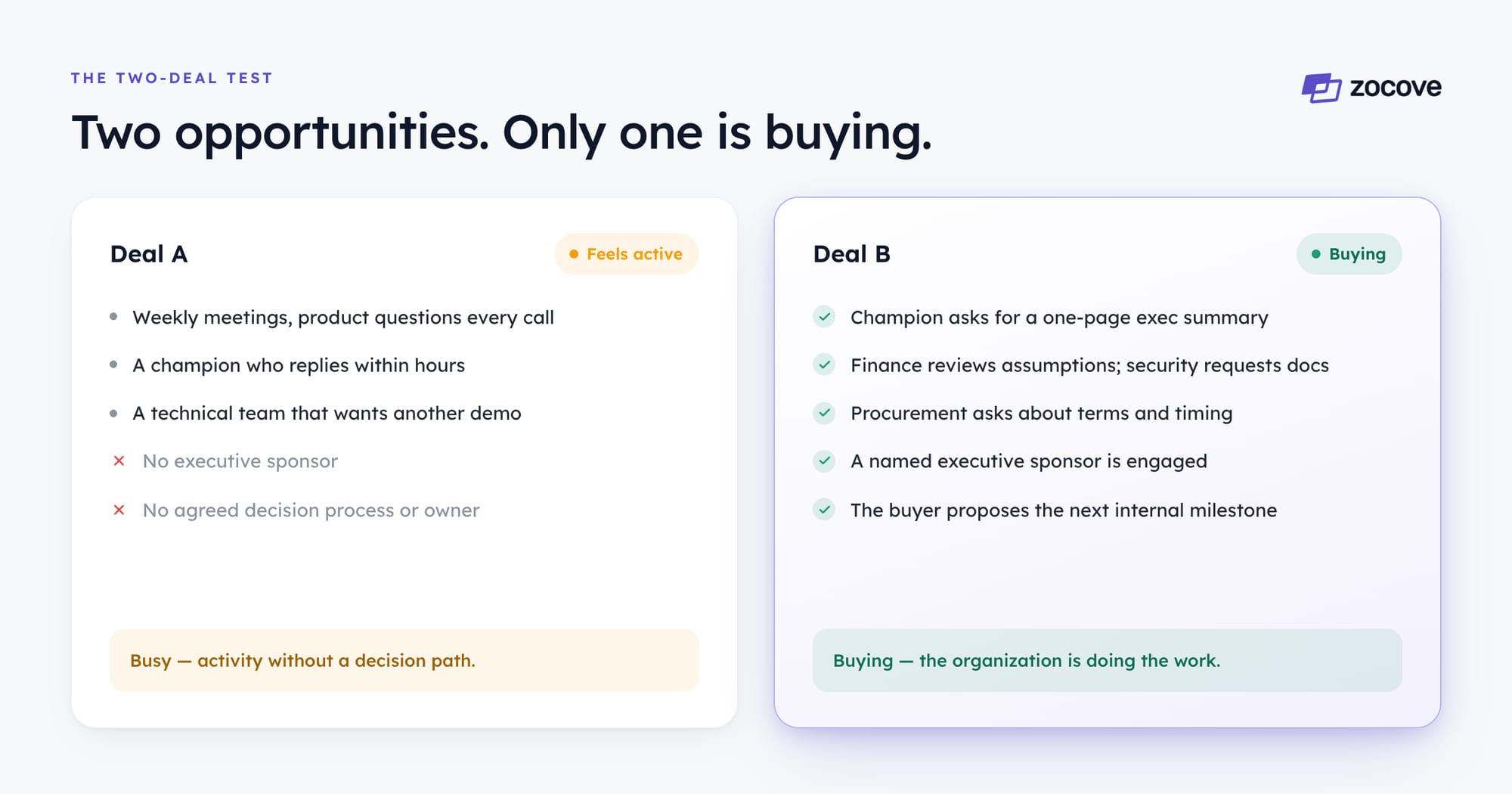
Deal A feels active; Deal B is buying. A seller who only measures volume will usually call Deal A the healthier one, while a seller who understands buying behavior will see the difference.
The four questions to ask every week
You do not need a complicated scorecard to separate activity from progress. Four questions will do it.
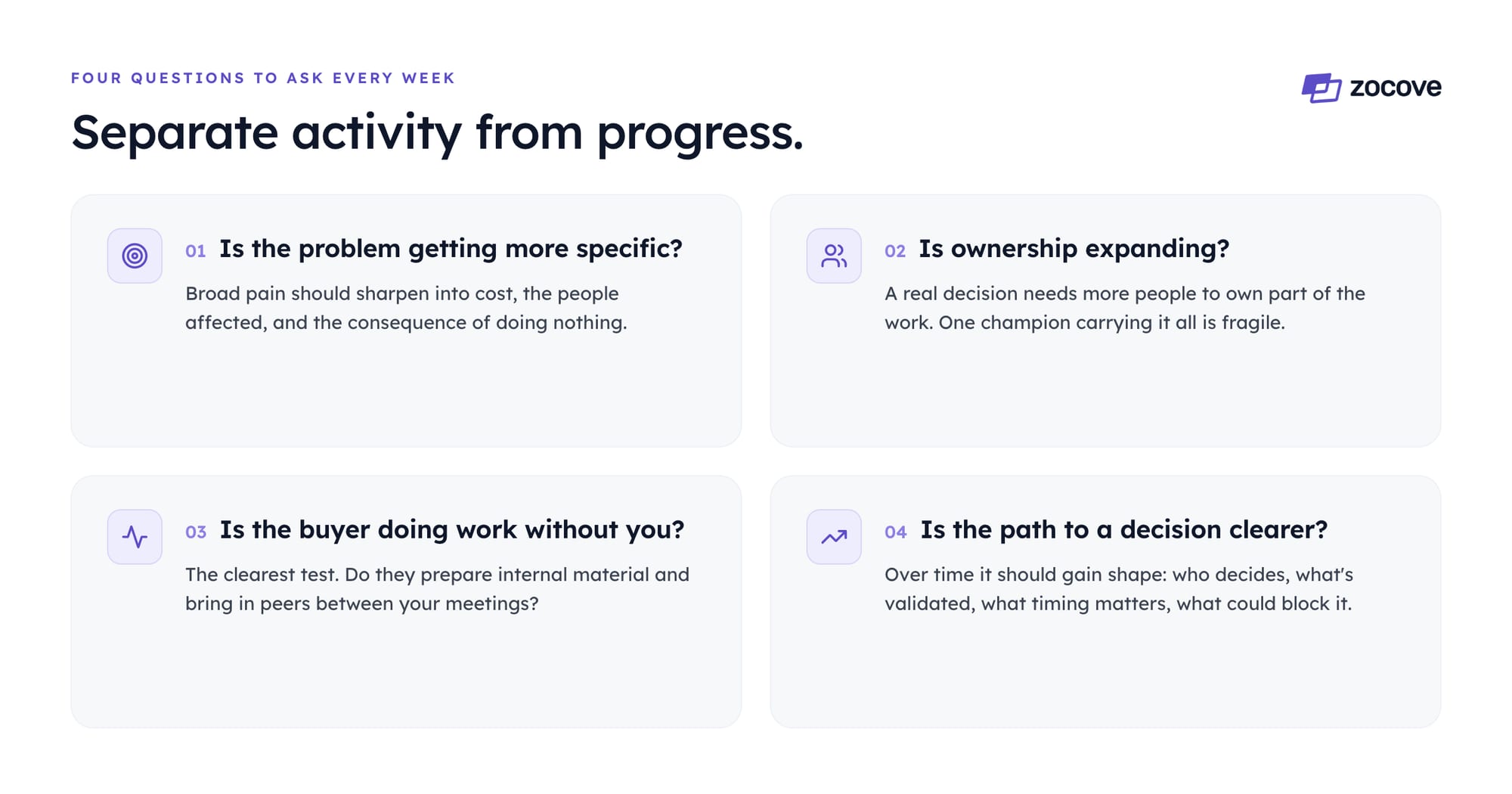
1. Is the problem getting more specific?
Early on, broad pain is normal. As buying progresses, the buyer starts defining the cost of the current state, the people affected, the requirements that matter, and the consequence of doing nothing. If the problem sounds exactly the same in week ten as it did in week two, the deal may be learning — not buying.
2. Is ownership expanding?
A real decision usually needs more people to own part of the work: someone owns the business case, someone owns technical validation, someone owns security, someone owns commercial process, and someone provides executive sponsorship. If every action still sits with a single champion, the deal may be busy but fragile.
3. Is the buyer doing work without you?
This is the clearest test. Are they preparing internal material, reviewing pricing assumptions, bringing in peers, comparing implementation paths, scheduling a security review, or asking what procurement will need? If all forward motion only happens when you schedule the next meeting, you are pushing the deal alone — and watching what buyers do between meetings is often the fastest way to tell the difference.
4. Is the path to a decision becoming clearer?
A buying deal does not need a perfect plan on day one, but over time the path should gain shape: who decides, what must be validated, what timing matters, what approvals are required, what could block the decision, and what happens if the buyer says yes. If the process is still vague late in the cycle, do not call the deal late-stage.
Do not punish healthy silence
One important caveat: not every quiet period is a bad sign. Enterprise buyers often need time to do real internal work — security reviews, budget discussions, and legal reviews all take time, and executive priorities shift. The answer is not to demand constant activity; it is to know what the buyer is working toward. A quiet deal with a clear buyer-owned milestone can be perfectly healthy, while a noisy deal with no decision path is not.
The seller's job is to help the deal become a buying deal
You cannot force a customer to prioritize a problem they do not own, but you can make it easier for a serious buyer to move. In practice, that means:
- Help define the business problem in their language
- Give the champion material that travels internally
- Ask who needs to become involved next
- Make the implementation and risk story easy to understand
- Turn vague next steps into buyer-owned decisions
- Treat commercial, security, and procurement questions as signs of progress when they are connected to a real process
The goal is not more activity. It is more evidence that the buyer is carrying the decision forward.
Final thoughts
A full calendar can be comforting, and it can also hide the fact that the buyer has not committed to anything. The best enterprise AEs learn to tell the two apart early. Instead of asking “how active is this deal?”, they ask a better question:
“What is the buyer doing that tells me they are moving toward a decision?”
That is the difference between a busy deal and a buying deal.